Summary

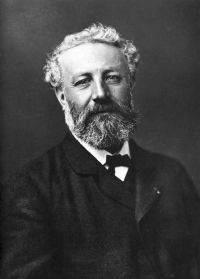
Portrait of Jules Verne Jules Verne Michael Strogoff (1876) — Chapter XXVIII (1876)

At any moment an incident might occur, which they could not escape unscathed.
For a man who hoped soon to accomplish his mission, Michael was singularly calm. Even in the gravest conjunctures, his energy had never abandoned him. He already saw the moment when he would be at last allowed to think of his mother, of Nadia, of himself! He now only dreaded one final unhappy chance; this was, that the raft might be completely barred by ice before reaching Irkutsk.
Source: Wikisource

Portrait of Jules Verne Jules Verne Michael Strogoff (1876) — Chapter XXVIII (1876)

At about ten o'clock, however, Harry Blount caught sight of a number of black objects moving on the ice blocks. Springing from one to the other, they rapidly approached.
"Tartars!" he thought. And creeping up to the old boatman, he pointed out to him the suspicious objects.
The old man looked attentively. "They are only wolves!" said he. "I like them better than Tartars. But we must defend ourselves, and without noise!"
The fugitives would indeed have to defend themselves against these ferocious beasts, whom hunger and cold had sent roaming through the province.
Source: Wikisource

Portrait of Jules Verne Jules Verne Michael Strogoff (1876) — Chapter XXVIII (1876)

It may be imagined what were the apprehensions of Jolivet and Blount, when they thought of the combustible liquid on which the raft floated. Sparks flew in millions from the houses, which resembled so many glowing furnaces. They rose among the volumes of smoke to a height of five or six hundred feet. On the right bank, the trees and cliffs exposed to the fire looked as if they likewise were burning. A spark falling on the surface of the Angara would be sufficient to spread the flames along the current, and to carry disaster from one bank to the other.
Source: Wikisource

Get perspective with Kwize: daily news enlightened by great literature