Summary

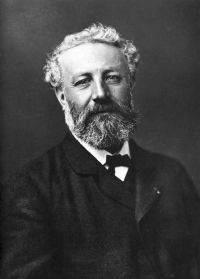
Portrait of Jules Verne Jules Verne The Adventures of Three Englishmen and Three Russians in Southern Africa…

Colonel Everest and Matthew Strux with their own hands placed the first rod. About a hundred toises farther on, they had marked a point of sight, and as the rods were each provided with iron projections, it was not difficult to place them exactly in the proper direction. Emery and Zorn, lying on the ground, saw that the projections stood exactly in the middle of the sight.
“Now,” said Colonel Everest, “we must define our exact starting-point. We will drop a line from the end of our first rod, and that will definitely mark the extremity of our base.”
Source: Wikisource

Portrait of Jules Verne Jules Verne The Adventures of Three Englishmen and Three Russians in Southern Africa…

THE BASE OF THE TRIANGLE.
The work undertaken by the Commission was a triangulation for the purpose of measuring an arc of meridian. Now the direct measurement of one or more degrees by means of metal rods would be impracticable. In no part of the world is there a region so vast and unbroken as to admit of so delicate an operation. Happily, there is an easier way of proceeding by dividing the region through which the meridian passes into a number of imaginary triangles, whose solution is comparatively easy.
Source: Wikisource

Portrait of Jules Verne Jules Verne The Adventures of Three Englishmen and Three Russians in Southern Africa…

These triangles are obtained by observing signals, either natural or artificial, such as church-towers, posts, or reverberatory lamps, by means of the theodolite or repeating-circle. Every signal is the vertex of a triangle, whose angles are exactly determined by the instruments, so that a good observer with a proper telescope can take the bearings of any object whatever, a tower by day, or a lamp by night.
Source: Wikisource

Get perspective with Kwize: daily news enlightened by great literature