Summary

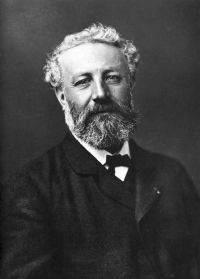
Portrait of Jules Verne Jules Verne The Adventures of Three Englishmen and Three Russians in Southern Africa…

The bushman would not permit that time should be wasted in any attack upon the reptiles, and restrained Sir John, who was always on the qui-vive to discharge a ball. Whenever a crocodile, snapping its prey with its formidable jaw, put its head out of water, the horses set off at a gallop to escape.
The troop of riders went on over woods, plains, and marshes, noting the most insignificant tokens: here a broken bough; there a freshly-trodden tuft of grass; or farther on some inexplicable mark; but no trace of Palander.
Source: Wikisource

Portrait of Jules Verne Jules Verne The Adventures of Three Englishmen and Three Russians in Southern Africa…

Mokoum's face flushed, and he answered impatiently,—
“Why should you expect me to take care of one who can't take care of himself? Why blame me? If Mr. Palander is lost, it is by his own folly. Twenty times I have found him absorbed in his figures, and have brought him back to the caravan. But the evening before last he disappeared, and I have not seen him since. Perhaps if you are so clever, you can spy him out with your telescope.”
The bushman would doubtless have become more irritable still, if Sir John had not pacified him.
Source: Wikisource

Portrait of Jules Verne Jules Verne The Adventures of Three Englishmen and Three Russians in Southern Africa…

Where any one else could find a subsistence, Palander, ever engrossed by his figures, would inevitably die of starvation. At one o'clock, guided by the hunter, they mounted and left the camp. The grotesque attitudes of Strux, as he clung uneasily to his steed, caused considerable diversion to his companions, who, however, were polite enough to pass no remark.
Before leaving the camp, Mokoum asked the pioneer to lend him his keen-scented dog.
Source: Wikisource

Get perspective with Kwize: daily news enlightened by great literature