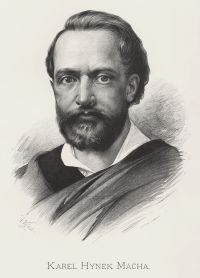
Karel Hynek Mácha

Karel Hynek Mácha

May (1932)

Summary

Portrait of Karel Hynek Mácha Karel Hynek Mácha May (1932)

Just as their very names, as battles of ancient hordes,
Just as the northern light, whose dead flame shines no more,
Tones of an age-warped harp, sounds of its shattered chords,
Events of by-gone days, the light of a lifeless star,
Feelings of one you loved, a wanderer's path so far,
A grave long since forgot, eternities' old scar,
A smold'ring fire's smoke, sounds of metallic chimes,
These are the echoes now of the dead man's childhood times.
'tis late at eve—second of May
A night in May—'tis time for love
A love lure sings the turtle-dove.
"William! William! William!"
Source: Wikisource

Portrait of Karel Hynek Mácha Karel Hynek Mácha May (1932)

And toward the wretched one their sympathies go out.
The throng with tear-filled eyes gazes upon the plain
Where the captive, looking over nature's wide domain
Humbled before his God—stands in a prayer devout.
The risen sunshine's crimson streaks
Color the captive's ashen cheeks,
And from his far-fixed, saddened eyes,
The falling tears, the sunshine dries.
A blossoming dale he sees beneath,
Encircled by a mountain's wreath,
And by a wreath that the forests make . . .
Peacefully sleeps the shining lake
Amidst the calm that this beauty brings.
Source: Wikisource

Portrait of Karel Hynek Mácha Karel Hynek Mácha May (1932)

True, Macha was a great lover of the poems of the proud Lord of Newstead Abbey, but Byron exercised an influence upon him more by his exotic personality, than through the intellectual qualities of his works. And so the most romantic element of Macha's power of feeling, a certain morbidity of a constantly recurring conception of death, his outright nihilistic notions of life and his horror of the Unknown, differ fundamentally by their elegiac passiveness from the tempestuous and titanic pathos of Byron's pessimism.
Source: Wikisource

Get perspective with Kwize: daily news enlightened by great literature