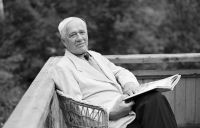
Korney Chukovsky

Korney Chukovsky

The Dial (1923)

Summary

Portrait of Korney Chukovsky Korney Chukovsky,  The Dial (1923)

“ He lived in Finland as in a desert. You travelled to distant countries, flew in aeroplanes, took part in battles, and returned to find with astonishment that Andreyev was still walking up and down his room, and continuing the monologue of nearly a year ago. And his enormous room this evening appeared suddenly very small—and his talk lonely. Was it not sad that an artist with such attentive, sharp, and eager eyes should see nothing besides snow, should sit within four walls and listen to the howling of the wind? ”
Source: Wikisource

Portrait of Korney Chukovsky Korney Chukovsky,  The Dial (1923)

“ He pronounced the word death in a special manner—with feeling and emphasis, as some voluptuaries pronounce the word woman. In this respect Andreyev possessed a great talent—he knew how to fear death as no one else could. To fear death is no easy matter: many attempt it, but without success. Andreyev succeeded magnicently: here was his real calling—to experience a deathly and terrible horror. This horror is to be discerned in all his books, and I think that his grasping at colour photography, gramophones, painting, constituted attempts to save himself from it. ”
Source: Wikisource

Portrait of Korney Chukovsky Korney Chukovsky,  The Dial (1923)

“ Only very talented people—only poets—are able to be children to the same extent. It is easy to imagine Pushkin's Mozart, playing at horses with delight: Salière reveals his absence of talent just by his incapacity for such play. When a child makes a railway out of chairs one has to be depressingly unimaginative to be able to tell it that the chairs are not really coaches. And the chief charm of Andreyev lay in the fact that whatever game he happened to be playing—and he was always playing some game or other—he believed in it firmly and gave himself to it without reserve. ”
Source: Wikisource

Get perspective with Kwize: daily news enlightened by great literature