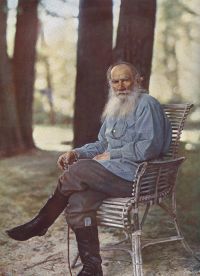
Leo Tolstoy

Leo Tolstoy

Summary

Portrait of Leo Tolstoy Leo Tolstoy The Cossacks — Chapter VI (1863)

The voices of the talking Cossacks vibrated more sonorously than before. The moving mass of the Terek's rapid brown waters contrasted more vividly with its motionless banks. The waters were beginning to subside and here and there the wet sands gleamed drab on the banks and in the shallows. The other side of the river, just opposite the cordon, was deserted; only an immense waste of low-growing reeds stretched far away to the very foot of the mountains. On the low bank, a little to one side, could be seen the flat-roofed clay houses and the funnel-shaped chimneys of a Chechen village.
Source: Wikisource

Portrait of Leo Tolstoy Leo Tolstoy The Cossacks — Chapter VI (1863)

Everything on a real brave is ample, ragged, and neglected, only his weapons are costly. But these ragged clothes and these weapons are belted and worn with a certain air and matched in a certain manner, neither of which can be acquired by everybody and which at once strike the eye of a Cossack or a hillsman. Lukashka had this resemblance to a brave. With his hands folded under his sword, and his eyes nearly closed, he kept looking at the distant Tartar village.
Source: Wikisource

Portrait of Leo Tolstoy Leo Tolstoy The Cossacks — Chapter VI (1863)

A pied mongrel half-setter, searching for a scent and violently wagging its scantily furred tail, came running to the cordon. Lukashka recognized the dog as one belonging to his neighbour, Uncle Eroshka, a hunter, and saw, following it through the thicket, the approaching figure of the hunter himself.
Uncle Eroshka was a gigantic Cossack with a broad, snow-white beard and such broad shoulders and chest that in the wood, where there was no one to compare him with, he did not look particularly tall, so well proportioned were his powerful limbs.
Source: Wikisource

Get perspective with Kwize: daily news enlightened by great literature