Summary

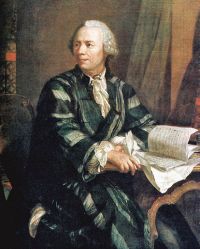
Portrait of Leonhard Euler Leonhard Euler,  Translation:Methodus inveniendi…

“ In the second case, the speed is not determined solely by the position of the particle; for example, the centers of force themselves may be moving or the particle may be in a resistant medium. Our principle pertains only to the first class of motion; in particular, even when a particle is attracted to multiple fixed centers of force, its momentum integrated along its trajectory should be minimal. ”
Source: Wikisource

Portrait of Leonhard Euler Leonhard Euler,  Translation:Methodus inveniendi…

“ Since , the forces acting on the particle at a point M can be grouped into two forces, a force that acts along the direction and another force that acts in the direction. These forces can themselves be resolved into a tangential force along the trajectory , and a normal force perpendicular to the trajectory . The normal force provides the local centripetal acceleration , where is the local radius of curvature of the trajectory. Thus, our principle of deriving mechanics from a principle of maxima and minima conforms with experience. ”
Source: Wikisource

Portrait of Leonhard Euler Leonhard Euler,  Translation:Methodus inveniendi…

“ Let the mass of a moving particle be , and let its speed be while being moved over an infinitesimal distance ds. The particle will have a momentum that, when multiplied by the distance ds, gives , the momentum of the particle integrated over the distance ds. Now I assert that the true trajectory of the moving particle is the trajectory to be described (from among all possible trajectories connecting the same endpoints) that minimizes or (since M is constant) . ”
Source: Wikisource

Get perspective with Kwize: daily news enlightened by great literature