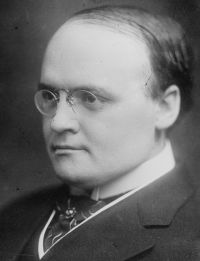
Louis Joseph Vance

Louis Joseph Vance

Summary

Portrait of Louis Joseph Vance Louis Joseph Vance The Trey o' Hearts (1914)

The-man settled down to work with grim determination, pitting courage and strength and experience against the ravening, bellowing waters that tore at the canoe on every hand.
He fought like one possessed. There was never an instant's grace between judgment and execution; and both must be instantaneous, or else—destruction. Again and again the canoe plunged wildly toward the instant annihilation which was avoided only by the timely plunge of a paddle, guided by luck or instinct or both. The one ray of hope in Alan's mind sprang from the fact that, however rough, the rapids were short.
Source: Wikisource

Portrait of Louis Joseph Vance Louis Joseph Vance The Trey o' Hearts (1914)

Alan caught his friend's hand and pressed it warmly, a caress eloquent of his gratitude to Barcus for taking their peril lightly, or pretending to, for the sake of Rose.
A ticklish business, that—groping their way through blackness so opaque that it seemed palpable. An elbow in the tunnel—sensed rather than felt or seen—cut them off from direct communication with the bulkhead, and at the same time opened up a shaft of daylight striking down through that pitchy darkness like a column of gold.
Source: Wikisource

Portrait of Louis Joseph Vance Louis Joseph Vance The Trey o' Hearts (1914)

For some time subsequent to the collision fog-signals sounding now near, now far, in the encompassing obscurity had fostered hope; but now for more than an hour the silence had been uncannily constant, broken only by the rumble of the motor, the lisp of water slipping down the slide, the suck and gurgle of the wake.
Forebodings no less portentous than Law's crawled in the mind of Barcus. It was as likely as not that the lifeboat was travelling straight out to sea. And gasoline tanks can and oftentimes do become—empty.
Source: Wikisource

Get perspective with Kwize: daily news enlightened by great literature