Summary

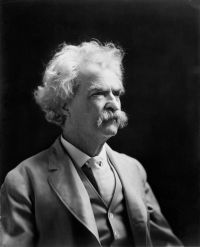
Portrait of Mark Twain Mark Twain,  Roughing It, Part 5

“ Such a marvel of funeral pomp had never been seen in Virginia. The plumed hearse, the dirge-breathing brass bands, the closed marts of business, the flags drooping at half mast, the long, plodding procession of uniformed secret societies, military battalions and fire companies, draped engines, carriages of officials, and citizens in vehicles and on foot, attracted multitudes of spectators to the sidewalks, roofs and windows; and for years afterward, the degree of grandeur attained by any civic display in Virginia was determined by comparison with Buck Fanshaw's funeral. ”
Source: Gutenberg

Portrait of Mark Twain Mark Twain,  Roughing It, Part 5

“ The men who murdered Virginia's original twenty-six cemetery-occupants were never punished. Why? Because Alfred the Great, when he invented trial by jury and knew that he had admirably framed it to secure justice in his age of the world, was not aware that in the nineteenth century the condition of things would be so entirely changed that unless he rose from the grave and altered the jury plan to meet the emergency, it would prove the most ingenious and infallible agency for defeating justice that human wisdom could contrive. ”
Source: Gutenberg

Portrait of Mark Twain Mark Twain,  Roughing It, Part 5

“ The "Ophir," the "Gould & Curry," the "Mexican," and other great mines on the Comstock lead in Virginia and Gold Hill were turning out huge piles of rich rock every day, and every man believed that his little wild cat claim was as good as any on the "main lead" and would infallibly be worth a thousand dollars a foot when he "got down where it came in solid." Poor fellow, he was blessedly blind to the fact that he never would see that day. So the thousand wild cat shafts burrowed deeper and deeper into the earth day by day, and all men were beside themselves with hope and happiness. ”
Source: Gutenberg

Get perspective with Kwize: daily news enlightened by great literature