Summary

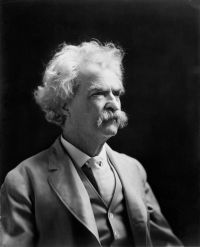
Portrait of Mark Twain Mark Twain The American Claimant — Chapter III (1892)

When I call him a failure, I mean to the world he's a failure; he isn't to me. I don't know as I want him different much different, anyway. I have to scold him some, snarl at him, you might even call it, but I reckon I'd do that just the same, if he was different—it's my make. But I'm a good deal less snarly and more contented when he's a failure than I am when he isn't."
"Then he isn't always a failure," said Hawking, brightening.
"Him? Oh, bless you, no. He makes a strike, as he calls it, from time to time. Then's my time to fret and fuss. For the money just flies—first come first served.
Source: Wikisource

Portrait of Mark Twain Mark Twain The American Claimant — Chapter III (1892)

Many a time he's made General Grant laugh—and that's a tidy job, I can tell you, and as for Sheridan, his eye lights up and he listens to Mulberry Sellers the same as if he was artillery. You see, the charm about Mulberry is, he is so catholic and unprejudiced that he fits in anywhere and everywhere. It makes him powerful good company, and as popular as scandal. You go to the White House when the President's holding a general reception—sometime when Mulberry's there.
Source: Wikisource

Portrait of Mark Twain Mark Twain The American Claimant — Chapter III (1892)

They quarrel together pretty much all the time—most always about religion, because Dan'l's a Dunker Baptist and Jinny's a shouting Methodist, and Jinny believes in special Providences and Dan'l don't, because he thinks he's a kind of a free-thinker—and they play and sing plantation hymns together, and talk and chatter just eternally and forever, and are sincerely fond of each other and think the world of Mulberry, and he puts up patiently with all their spoiled ways and foolishness, and so—ah, well, they're happy enough if it comes to that.
Source: Wikisource

Get perspective with Kwize: daily news enlightened by great literature