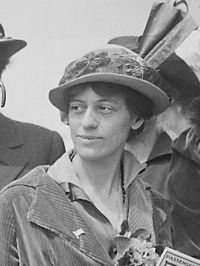
Mary Heaton Vorse

Mary Heaton Vorse

The Laugh (1918)

Summary

Portrait of Mary Heaton Vorse Mary Heaton Vorse The Laugh (1918)

Suddenly Tarleton stopped laughing; he thrust out his jaw at Allen menacingly, his face flushed to purple—to the color of the big mines—and a triangular patch of white on his forehead where the scar was gleamed out as if it had been greased.
"Talk!" he cried. "Who talks? What makes 'um come with me, then—they know me—what makes 'um come? They got eyes, 'ain't they—an' ears? They come o' their own free will, don't they? Oh, I know 'um. I don't put up no bluff with no girl. Let 'um stay home!" The storm had passed. His laughter boomed out again. "But they can't stay home—hey, Allen?—ho-ho-ho!
Source: Wikisource

Portrait of Mary Heaton Vorse Mary Heaton Vorse The Laugh (1918)

One went in by the kitchen door, not by the front door, at Dawes Hole. Tarleton knocked.
"What are you doing here?" Tessie cried. She was as stern as a sentencing judge.
"I—I—came— You don't understand—" he faltered. He had never asked a woman to marry him before—and meant it. "I—I—want to marry you, Tessie."
At that fury broke loose in her.
"Marry you!" she cried. "Marry you!"
"Tessie—don't—you understand?" He couldn't believe it. It had never occurred to him that he could not have any woman he wanted. He had never even had to pay a price before.
The spectacle of her anger inflamed him.
Source: Wikisource

Portrait of Mary Heaton Vorse Mary Heaton Vorse The Laugh (1918)

NO one outside Dawes Hole knows how the strike on the Range started. Even in Dawes Hole they couldn't have told you that a laugh began it. Every one has different theories, from that of the easy explanation—"outside agitators"—that comes to the mine-owner's hand as readily as a half-brick to the hand of a street urchin, to the grandiloquent and idealistic one put forward by the champion of labor—"a spontaneous uprising of the people."
Source: Wikisource

Get perspective with Kwize: daily news enlightened by great literature