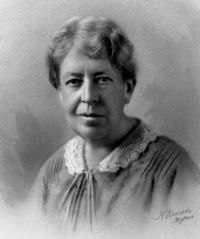
Mary Whiton Calkins

Mary Whiton Calkins

Summary

Portrait of Mary Whiton Calkins Mary Whiton Calkins Militant Pacifism (1917)

The outcome of our study of pugnacity is, thus, the assurance that war is not the inevitable result of unmodifiable instinct. But this conclusion leaves us with our ethical problem still on our hands. We have still to examine the ethical doctrine that war is morally, if not psychically, inevitable—that war must be cherished as an awful but necessary human experience which purges men’s souls of cowardice and selfishness and fans to a flame the fires of courage and devotion. That war may—nay, always does—create and invigorate daring and sacrifice no student of history will deny.
Source: Wikisource

Portrait of Mary Whiton Calkins Mary Whiton Calkins Militant Pacifism (1917)

This truth, that there is inherent inconsistency at the heart of every just war, and the sad fact that a war, unless it is on both sides the outgrowth of popular fear, must be, on one side at least, a war of aggrandizement, illumine with blinding light the truth that no individual or nation can be trusted to define its own rights and then to fight for them, to act, in a word, at once as advocate, judge, and inflicter of punishment in its own cause.
Source: Wikisource

Portrait of Mary Whiton Calkins Mary Whiton Calkins Militant Pacifism (1917)

It is unquestionably true that those who dare to hope and to work for the end of war must meet the protest of the critics who hold that this instinct is irrepressible and that war is, therefore, ineradicable. It is vain, these critics insist, to hope, to plan, to work for a league of nations, a world-state, a reign of perpetual peace.
Source: Wikisource

Get perspective with Kwize: daily news enlightened by great literature