Summary

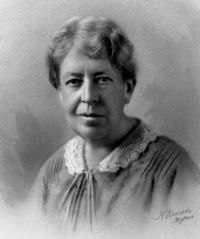
Portrait of Mary Whiton Calkins Mary Whiton Calkins Mr. Muscio's Criticism of Miss Calkins's Reply to the Realist (1912)

But I insist that a sense quality is mental, or ideal, in a genuinely idealistic sense, that is, as aspect or “content” of a self. Thus “yellow” is a certain experience which a self has (or which selves have) ; just as any relation (whether knowledge, or dependence, or influence) ultimately is a self-in-its-relating,—a self as knowing, depending, or acting. And again I ask Mr. Muscio and the other critics of idealism to make any other unchallengeable assertions about sense-qualities.
Source: Wikisource

Portrait of Mary Whiton Calkins Mary Whiton Calkins Mr. Muscio's Criticism of Miss Calkins's Reply to the Realist (1912)

The ‘idealist’ we are told, ‘rests his case ... on the results of direct observation coupled with the inability of any observer to make an unchallengeable assertion about sense qualities save in the terms of idealism. To be more explicit: The idealist demands that his opponent describe any immediately perceived sense object in such wise that his description can not be disputed. The realist describes an object as, let us say, yellow, rough, and cold.
Source: Wikisource

Portrait of Mary Whiton Calkins Mary Whiton Calkins Mr. Muscio's Criticism of Miss Calkins's Reply to the Realist (1912)

But somebody may deny the yellowness, the roughness, or the coldness; and this throws the realist back on what he directly observes, what he knows with incontrovertible and undeniable certainty, namely, that he is at this moment having a complex experience described by the terms yellowness, coldness, and the like (an experience which he does not give himself) .
Source: Wikisource

Get perspective with Kwize: daily news enlightened by great literature