Summary

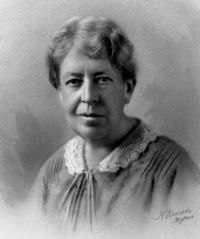
Portrait of Mary Whiton Calkins Mary Whiton Calkins The New Rationalism and Objective Idealism (1919)

An ego, therefore, if it exists, must modify the objects related to it. But the specific relation of an ego to objects can be no other than its consciousness or knowledge of them; and the realist has argued that objects are independent of—unmodified by—being known. Obviously, therefore, the realist concludes, if knowledge does not modify its objects there can be no modifying or causal ego.
Source: Wikisource

Portrait of Mary Whiton Calkins Mary Whiton Calkins The New Rationalism and Objective Idealism (1919)

This criticism, however, of Spaulding’s argument against the conceivableness of the ego, still leaves on our hands his more formidable argument against idealism. For to Spaulding, whatever might prove to be the nature of knower or of knowledge (of self or of consciousness) , the known object still would exist, independent of both, by virtue of the realistic solution of the egocentric predicament.
Source: Wikisource

Get perspective with Kwize: daily news enlightened by great literature