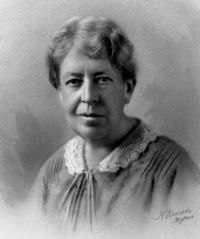
Mary Whiton Calkins

Mary Whiton Calkins

Summary

Portrait of Mary Whiton Calkins Mary Whiton Calkins The Idealist to the Realist (1911)

As an idealist, I agree to check myself in every exuberant denial of the possibility that unknown extra-mental objects exist. But I do not hereby recant my idealism. For the truth is that the hypothetical unknown, extra-mental reality is utterly negligible. Such an x, an utterly unknown extra-mental object, is not the object of physical science, of logic, or of mathematics
Source: Wikisource

Portrait of Mary Whiton Calkins Mary Whiton Calkins The Idealist to the Realist (1911)

Idealism, it is urged, is necessarily solipsistic. The basal tenet of idealism, the critics insist, is the peculiar or unique certainty of the existence of myself, a single conscious self. But the idealist (so the realists point out) who refuses to argue from this certainty of his own existence to the existence of extra-mental objects is equally debarred from arguing to the existence of selves external to him.
Source: Wikisource

Portrait of Mary Whiton Calkins Mary Whiton Calkins The Idealist to the Realist (1911)

The charge that idealism flies in the face of common sense, of science, and of logic reappears in the writings of many realists. In the words of Professor Woodbridge, idealism “forces upon one a view of things which is not an extension and a refinement of [the] natural, instinctive view, but a radical transformation of it.” [2] And Professor Spaulding introduces his summary of realistic doctrine with the statement that realism “agrees with common sense and with science.”
Source: Wikisource

Get perspective with Kwize: daily news enlightened by great literature