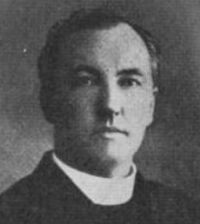
Maurice M. Hassett

Maurice M. Hassett

Summary

Portrait of Maurice M. Hassett Maurice M. Hassett Catholic Encyclopedia (1913)

The existence of the custom among pagans is referred to by Clement of Alexandria, who states that their "most ancient temples looked towards the West, that people might be taught to turn to the East when facing the images" (Stromata, vii. 17, 43) . The form of orientation which in the Middle Ages was generally adopted consisted in placing the apse and altar in the Eastern end of the basilica. A system of orientation exactly the opposite of this was adopted in the basilicas of the age of Constantine.
Source: Wikisource

Portrait of Maurice M. Hassett Maurice M. Hassett Catholic Encyclopedia (1913)

Altars of the tomb type, like the sarcophagi of the Constantinian epoch, offered a surface the front of which was well adapted to sculptured decoration. The earliest existing example of an altar with a carved antependium, however, in the Church of Cividale, dates from the beginning of the eighth century. Our Lord is here represented in the centre of the antependium, accompanied by angels, while the hand of the Father appears above His head. Of greater interest is the antependium, as well as the side panels, of the altar of the Ambrosian basilica in Milan.
Source: Wikisource

Portrait of Maurice M. Hassett Maurice M. Hassett Catholic Encyclopedia (1913)

Christ before men at the cost of their lives—hence the name confessio was applied to their last resting-place, when, as happened frequently from the fourth century, an altar was erected over it. Up to the seventh century in Rome, as we learn from a letter of St. Gregory the Great to the Empress Constantia, a strong sentiment against disturbing the bodies of the martyrs prevailed. This fact accounts for the erection of the early Roman basilicas, no matter what the obstacles encountered, over the tombs of martyrs; the church was brought to the martyr, not the martyr to the church.
Source: Wikisource

Get perspective with Kwize: daily news enlightened by great literature