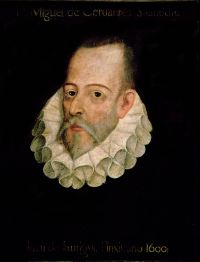
Miguel de Cervantes Saavedra

Miguel de Cervantes Saavedra

Summary

Portrait of Miguel de Cervantes Saavedra Miguel de Cervantes Saavedra The History of Don Quixote, Volume 1…

Humble with the proud, haughty with the humble, encounterer of dangers, endurer of outrages, enamoured without reason, imitator of the good, scourge of the wicked, enemy of the mean, in short, knight-errant, which is all that can be said!"
At the cries and moans of Sancho, Don Quixote came to himself, and the first word he said was, "He who lives separated from you, sweetest Dulcinea, has greater miseries to endure than these. Aid me, friend Sancho, to mount the enchanted cart, for I am not in a condition to press the saddle of Rocinante, as this shoulder is all knocked to pieces."
Source: Gutenberg

Portrait of Miguel de Cervantes Saavedra Miguel de Cervantes Saavedra The History of Don Quixote, Volume 1…

PANIAGUADO, ACADEMICIAN OF ARGAMASILLA, IN LAUDEM DULCINEAE DEL TOBOSO SONNET She, whose full features may be here descried, High-bosomed, with a bearing of disdain, Is Dulcinea, she for whom in vain The great Don Quixote of La Mancha sighed. For her, Toboso's queen, from side to side He traversed the grim sierra, the champaign Of Aranjuez, and Montiel's famous plain: On Rocinante oft a weary ride. Malignant planets, cruel destiny, Pursued them both, the fair Manchegan dame, And the unconquered star of chivalry. Nor youth nor beauty saved her from the claim Of death
Source: Gutenberg

Portrait of Miguel de Cervantes Saavedra Miguel de Cervantes Saavedra The History of Don Quixote, Volume 1…

CACHIDIABLO, ACADEMICIAN OF ARGAMASILLA, ON THE TOMB OF DON QUIXOTE EPITAPH The knight lies here below, Ill-errant and bruised sore, Whom Rocinante bore In his wanderings to and fro. By the side of the knight is laid Stolid man Sancho too, Than whom a squire more true Was not in the esquire trade. TIQUITOC, ACADEMICIAN OF ARGAMASILLA, ON THE TOMB OF DULCINEA DEL TOBOSO EPITAPH Here Dulcinea lies. Plump was she and robust: Now she is ashes and dust: The end of all flesh that dies.
Source: Gutenberg

Get perspective with Kwize: daily news enlightened by great literature