“ Shandy, there is nothing of Sancho about his brother. But the serio-comic game of cross-purposes is the same between both couples; and what one may call the irony of human intercourse is equally profound, and pointed with equal subtlety, in each. In the Spanish romance, of course, it is not likely to be missed. It is enough in itself that the deranged brain which takes windmills for giants, and carriers for knights, and Rosinante for a Bucephalus, has fixed upon Sancho Panza—the crowning proof of its mania—as the fitting squire of a knight-errant. ”
Sancho Panza
Definition and stakes
Sancho Panza, a fictional character from Miguel de Cervantes’ Don Quixote, serves as the earthy, practical squire to the delusional knight-errant Don Quixote. His wit, rooted in Spanish proverbs and common sense, contrasts sharply with his master’s chivalric fantasies. Authors like H. D. Traill emphasize his role as a counterpoint to Quixote’s madness, while Eva March Tappan highlights his narrative function in tempering the chaos of the adventures.
John Dos Passos portrays Sancho’s philosophy as an appreciation for life’s simplicity, and Cervantes himself depicts his transformation from a skeptical everyman to a figure quietly shaped by Quixote’s idealism. This duality—pragmatism giving way to romanticism—captures the novel’s examination of reality versus illusion.
Quotes about “Sancho Panza”
The Junior Classics, Volume 4: Heroes and heroines of chivalry
“ Sancho Panza knew them instantly, but wanted to conceal the place and manner in which the knight remained, and answered that his master was kept in a certain place by affairs of the greatest importance of which he must say nothing."That will not do, friend Sancho," said the barber. "If thou dost not tell us where he is, we shall believe that thou hast robbed and slain him, seeing that thou art riding his horse. Verily thou must find us the owner of the steed, or it will be the worse for thee." ”
Eva March Tappan, The Children's Hour, v 5. Stories From Seven Old Favorites
“ Sancho Panza came running out of Don Quixote's chamber in a terrible fright, crying out, "Help, help, good people, help my master! He is just now at it, tooth and nail, with that same giant, the Princess Micomicona's foe; I never saw a more dreadful battle in my born days. He has lent him such a sliver, that whip off went the giant's head, as round as a turnip."—"You are mad, Sancho," said the curate, interrupted in his reading; "is thy master such a devil of a hero, as to fight a giant at two thousand leagues' distance?" ”

Related terms
Authors who wrote about “Sancho Panza”
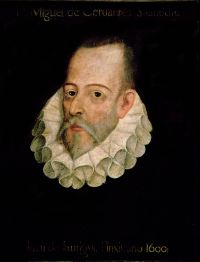 Miguel de Cervantes Saavedra
 Miguel de CervantesEva March Tappan
 Ignatius SanchoCharles Herbert SylvesterVarious
 George Sand
 Lewis Spence
 John Dos PassosC. A. Bloss
 Miguel de UnamunoPedro SanchoClayton EdwardsH. D. TraillOntario. Department of EducationWilliam A. QuayleWalter Cooper Dendy
 Ebenezer Cobham BrewerJames Fitzmaurice-Kelly
 Anatole France