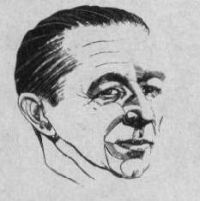
Murray Leinster

Murray Leinster

Summary

Portrait of Murray Leinster Murray Leinster Planet of Sand (1948)

The cosmos was small and limited and the Stallifer was huge. Then the skid's drive came on. It shot away from the hull—and the ship vanished as utterly as a blown-out candle flame. And the universe was so vast as to produce a cringing sensation in the man who straddled an absurd small device in such emptiness, with one cold white sun—barely near enough to show a disk—and innumerable remote and indifferent stars on every hand.
On the instant when the ship's field contracted and left him outside, Stan had lost the incredible velocity the field imparts.
Source: Gutenberg

Portrait of Murray Leinster Murray Leinster Planet of Sand (1948)

Emptiness opened beneath the skid as sand went whirling up in a sandspout the exact equivalent of a waterspout at sea. Stan and Esther and the skid itself would have been torn away by its violence but that the skid's drive was on full, now. The absurd little traveler thrust sturdily downward. When sand was drawn away by wind, it burrowed down eagerly to make the most of its gain.
Source: Gutenberg

Portrait of Murray Leinster Murray Leinster Planet of Sand (1948)

The instant the skid touched ground, Stan made a warning gesture and reached over to turn off Esther's suit-radio. He opened his own face-plate and almost gasped at the chill of the midnight air. With no clouds or water vapor to hinder it, the heat stored up by day was radiated out to the awful chill of interstellar space at a rate which brought below zero temperatures within hours of sundown. At the winter pole of the planet, the air itself must come close to turning liquid from the cold. But here, and now, Stan nodded in his helmet as Esther opened her face-plate.
Source: Gutenberg

Get perspective with Kwize: daily news enlightened by great literature