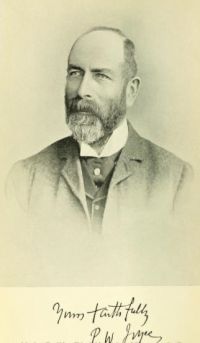
Patrick Weston Joyce

Patrick Weston Joyce

Summary

Portrait of Patrick Weston Joyce Patrick Weston Joyce English as we speak it in Ireland… (1910)

The same mode of expressing existence by an or in is found in the Ulster and Scotch phrase for to be alone, which is as follows, always bringing in the personal pronoun:—'I am in my lone,' 'he is in his lone,' 'they are in their lone'; or more commonly omitting the preposition (though it is always understood) : 'She is living her lone.' All these expressions are merely translations from Gaelic, in which they are constantly used; 'I am in my lone' being from Tá me am' aonar, where am' is 'in my' and aonar, 'lone.' Am' aonar seal do bhiossa, 'Once as I was alone.' (Old Irish Song.)
Source: Wikisource

Portrait of Patrick Weston Joyce Patrick Weston Joyce English as we speak it in Ireland… (1910)

In our Anglo-Irish dialect the expression at all is often duplicated for emphasis: ‘I'll grow no corn this year at all at all’: ‘I have no money at all at all.’ So prevalent is this among us that in a very good English grammar recently published (written by an Irishman) speakers and writers are warned against it. This is an importation from Irish.
Source: Wikisource

Portrait of Patrick Weston Joyce Patrick Weston Joyce English as we speak it in Ireland… (1910)

Our Irish-English expression ‘to come round a person’ means to induce or circumvent him by coaxing cuteness and wheedling: ‘He came round me by his sleudering to lend him half a crown, fool that I was’: ‘My grandchildren came round me to give them money for sweets.’ This expression is borrowed from Irish:—'When the Milesians reached Erin tanic a ngáes timchioll Tuathi De Danand, ‘their cuteness circumvented (lit. ‘came round’) the Dedannans.’ (Opening sentence in Mesca Ulad in Book of Leinster: Hennessy.)
Source: Wikisource

Get perspective with Kwize: daily news enlightened by great literature