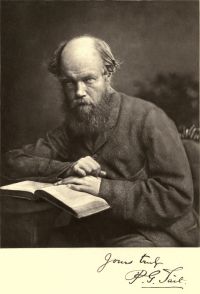
Peter Guthrie Tait

Peter Guthrie Tait

Summary

Portrait of Peter Guthrie Tait Peter Guthrie Tait 1911 Encyclopædia Britannica (1911)

It was in the successful effort to open this treasure-house that Hamilton’s mind received its final temper, “Dès-lors il commença à marcher seul,” to use the words of the biographer of another great mathematician. From that time he appears to have devoted himself almost wholly to original investigation (so far at least as regards mathematics) , though he ever kept himself well acquainted with the progress of science both in Britain and abroad.
Source: Wikisource

Portrait of Peter Guthrie Tait Peter Guthrie Tait 1911 Encyclopædia Britannica (1911)

C. G. J. Jacobi and other mathematicians have developed to a great extent, and as a question of pure mathematics only, Hamilton’s processes, and have thus made extensive additions to our knowledge of differential equations. But there can be little doubt that we have as yet obtained only a mere glimpse of the vast physical results of which they contain the germ. And though this is of course by far the more valuable aspect in which any such contribution to science can be looked at, the other must not be despised.
Source: Wikisource

Portrait of Peter Guthrie Tait Peter Guthrie Tait 1911 Encyclopædia Britannica (1911)

About this period he was also engaged in preparation for entrance at Trinity College, Dublin, and had therefore to devote a portion of his time to classics. In the summer of 1822, in his seventeenth year, he began a systematic study of Laplace’s Mécanique Céleste. Nothing could be better fitted to call forth such mathematical powers as those of Hamilton; for Laplace’s great work, rich to profusion in analytical processes alike novel and powerful, demands from the most gifted student careful and often laborious study.
Source: Wikisource

Get perspective with Kwize: daily news enlightened by great literature