Summary

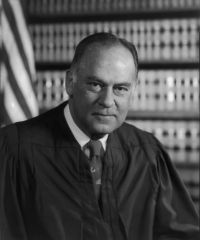
Portrait of Potter Stewart Potter Stewart O'Connor v. Donaldson — Opinion of the Court (1975)

In short, a State cannot constitutionally confine without more a nondangerous individual who is capable of surviving safely in freedom by himself or with the help of willing and responsible family members or friends. Since the jury found, upon ample evidence, that O'Connor, as an agent of the State, knowingly did so confine Donaldson, it properly concluded that O'Connor violated Donaldson's constitutional right to freedom.
Source: Wikisource

Portrait of Potter Stewart Potter Stewart O'Connor v. Donaldson — Opinion of the Court (1975)

O'Connor argues that, despite the jury's verdict, the Court must assume that Donaldson was receiving treatment sufficient to justify his confinement, because the adequacy of treatment is a "nonjusticiable" question that must be left to the discretion of the psychiatric profession. That argument is unpersuasive. Where "treatment" is the sole asserted ground for depriving a person of liberty, it is plainly unacceptable to suggest that the courts are powerless to determine whether the asserted ground is present.
Source: Wikisource

Portrait of Potter Stewart Potter Stewart O'Connor v. Donaldson — Opinion of the Court (1975)

May the State fence in the harmless mentally ill solely to save its citizens from exposure to those whose ways are different? One might as well ask if the State, to avoid public unease, could incarcerate all who are physically unattractive or socially eccentric. Mere public intolerance or animosity cannot constitutionally justify the deprivation of a person's physical liberty.
Source: Wikisource

Get perspective with Kwize: daily news enlightened by great literature