Summary

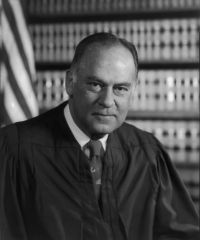
Portrait of Potter Stewart Potter Stewart Rideau v. Louisiana — Opinion of the Court

Under our Constitution's guarantee of due process, a person accused of committing a crime is vouchsafed basic minimal rights. Among these are the right to counsel, [3] the right to plead not guilty, and the right to be tried in a courtroom presided over by a judge. Yet in this case the people of Calcasieu Parish saw and heard, not once but three times, a 'trial' of Rideau in a jail, presided over by a sheriff, where there was no lawyer to advise Rideau of his right to stand mute.
Source: Wikisource

Portrait of Potter Stewart Potter Stewart Rideau v. Louisiana — Opinion of the Court

Calcasieu Parish has a population of approximately 150,000 people.
Some two weeks later, Rideau was arraigned on charges of armed robbery, kidnapping, and murder, and two lawyers were appointed to represent him. His lawyers promptly filed a motion for a change of venue, on the ground that it would deprive Rideau of rights guaranteed to him by the United States Constitution to force him to trial in Calcasieu Parish after the three television broadcasts there of his 'interview' with the sheriff.
Source: Wikisource

Portrait of Potter Stewart Potter Stewart Rideau v. Louisiana — Opinion of the Court

Mississippi, 297 U.S. 278, 56 S.Ct. 461, 80 L.Ed. 682, this Court set aside murder convictions secured in a state trial with all the formalities of fair procedures, based upon 'free and voluntary confessions' which in fact had been preceded by grossly brutal kangaroo court proceedings while the defendants were held in jail without counsel. As Chief Justice Hughes wrote in that case, 'The state is free to regulate the procedure of its courts in accordance with its own conceptions of policy * * *.
Source: Wikisource

Get perspective with Kwize: daily news enlightened by great literature