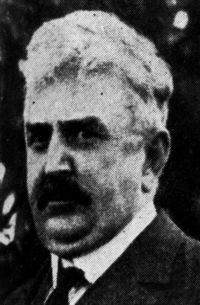
Raymond S. Spears

Raymond S. Spears

Lonesome (1923)

Summary

Portrait of Raymond S. Spears Raymond S. Spears Lonesome (1923)

Thus he discovered a runway where men-folk traveled. He walked beside it in the quiet of night. He had walked in deer-trails, over passes where footpaths of many kinds of creatures converged into one, and he knew cattle tracks, cut deep and wide by heavy hoofs. The reeking man-tracks bespoke of dangerous, but interesting, creatures.
It was night. He was a lucky cougar. He heard a man coming. The man was in a lonely mood, too. At least he was making loud sounds. His voice rose and fell hoarsely, like the voice of a strong human.
Source: Wikisource

Portrait of Raymond S. Spears Raymond S. Spears Lonesome (1923)

Humans didn't care who heard them! He saw the walker, a woman. She was up the slope from the trail, picking juniper berries in a clangorous tin pail.
She was Rose Stanley, from down at the dusty spaces of the Edem ranch. It had been her good fortune to escape alone to the junipers, which Toyab Edem would have objected to, had he known. Toyab could not understand why or how a young woman could prefer the timber-line without him, rather than with him hanging around. She had run away to avoid him.
Source: Wikisource

Portrait of Raymond S. Spears Raymond S. Spears Lonesome (1923)

By and by he returned again to the trail. Man tracks possessed a kind of fascination for him. The cries of mankind fell like pleasant music on the huge feline's ears. He recalled his sensations with a wish to enjoy them again. Accordingly he returned to the lonely mountain pass and lurked along it, being so eager that he did not wait for night, but with infinite caution and slowest of creepings ventured near the dangerously fascinating runway.
He was disappointed. He saw no one. He grew stomach-hungry, waiting for an other human to ride by on horseback, singing in the broad day.
Source: Wikisource

Get perspective with Kwize: daily news enlightened by great literature