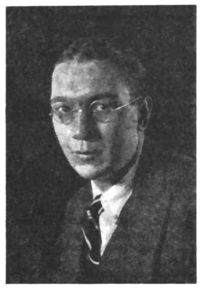
Richard Connell

Richard Connell

Summary

Portrait of Richard Connell Richard Connell A Nose for News (1822)

But a man does not make seven million dollars, as Colonel Fowler had, by yielding to every passing fit of passion. He had only recently bought The Morning Voice, but he knew its history; he could remember the anemic state of its circulation and the paucity of its advertising in the distant days before Marcus Quigley became its guiding spirit. That nose of Mr. Quigley's had breathed life into the Morning Voice and made it the necessary breakfast companion of a quarter of a million people. The colonel was too shrewd a newspaper man himself not to see the asset he had in that nose.
Source: Wikisource

Portrait of Richard Connell Richard Connell A Nose for News (1822)

But even the staff did not understand how utterly the getting and printing of news absorbed the small man with the huge nose. To him it was a fetish—and more: it was his religion.
Once in a great while he gave voice to what was always in his mind, and preached his gospel to a group of reporters.
“A newspaper lives to give news. If it does not give the news—all the news—fully, clearly, it is no newspaper, but a dead rag. A newspaper is really a public institution, with a sacred duty to all the people.
“News is alive. It breathes. It has personality.
Source: Wikisource

Portrait of Richard Connell Richard Connell A Nose for News (1822)

His long fingers closed on the police bulletin and tightened on the sheet of paper that meant to him disgrace, and the loss of everything he valued. He had felt that he could weather the Sheehan storm, but this scandal, coming on top of it, would mean his banishment; he knew that. The cords on his knuckle stood out as he gripped the crumpled paper.
“Sixty, broke and jobless,” he muttered “And alone!” He pressed his temples with his fingers. And then: “But this is news.”
Source: Wikisource

Get perspective with Kwize: daily news enlightened by great literature