Summary

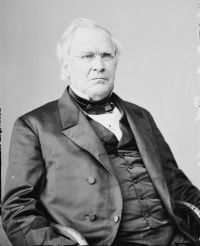
Portrait of Robert Cooper Grier Robert Cooper Grier United States v. Sutherland — Opinion of the Court

The patent to the claimant's mother confers a title in fee to an estate 'known by the name of El Cahon,' or 'The Chest.' It describes it as lying 'near the mission of San Diego.' It therefore assumes, that there is an estate or rancho having such a name, and having some known boundaries.
It is prima facie evidence of such a fact. Those who allege that it is void for uncertainty, must prove either that there are two estates called 'El Cahon,' near the mission of San Diego, to which the description in the patent would equally apply
Source: Wikisource

Portrait of Robert Cooper Grier Robert Cooper Grier United States v. Sutherland — Opinion of the Court

The millions of acres of land around them, with the exception of a mission or a rancho on some favored spot, were uninhabited and uncultivated. It was the interest and the policy of the King of Spain, and afterwards of the Mexican Government, to make liberal grants of these lands to those who would engage to colonize or settle upon them. Where land is plenty and labor scarce, pasturage and raising of cattle promised the greatest reward with the least labor.
Source: Wikisource

Portrait of Robert Cooper Grier Robert Cooper Grier United States v. Sutherland — Opinion of the Court

A square league, or 'sitio de ganado mayor,' appears to have been the only unit in estimating the superficies of land. Eleven of these leagues was the usual extent for a rancho grant. If more or less was intended in the grant, it was carefully stated. Surveying instruments or surveyors were seldom to be obtained in distant locations. The applicant for land usually accompanied his petition with a dise no, or map, showing the natural boundaries or monuments of the tract desired.
Source: Wikisource

Get perspective with Kwize: daily news enlightened by great literature