Summary

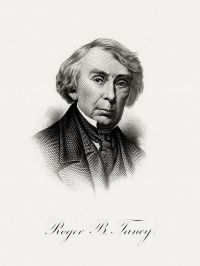
Portrait of Roger B. Taney Roger B. Taney Prouty v. Ruggles — Opinion of the Court

The counsel of plaintiffs respectfully move the court to instruct the jury, that if the defendants have used, in combination with the other two parts, a standard, of the description set forth in the specification, and it is proved to serve both for brace and draft, such use was an infringement of the plaintiffs' claim in that particular, although the defendants may not have inserted into a jog in the beam.
Source: Wikisource

Portrait of Roger B. Taney Roger B. Taney Prouty v. Ruggles — Opinion of the Court

The bolts which we use to fasten the pieces of cast iron, of which our ploughs are made, together, and the wood-work, are round, with inverted convex heads, like the wood-screw, with a projection on the under side of the head, of semicircular form, which fits into a groove in the counter-sink part of the bolt-hole, as it is cast to receive it, which not only prevents its turning, but also diminishes the liability of breakage at the corners of square holes
Source: Wikisource

Portrait of Roger B. Taney Roger B. Taney Prouty v. Ruggles — Opinion of the Court

The top of the standard, through which the bolt passes to secure the beam, is transversely parallel to the plane of the share, and extends back from the bolt to such distance as to form a brace to the beam, when the after-part is passed down by lifting at the forepart; the share being fast under a rock, or other obstruction, the after-part of this extension is squared in such manner, that being jogged into the beam, it relieves the bolt in heavy draft.
Source: Wikisource

Get perspective with Kwize: daily news enlightened by great literature