Summary

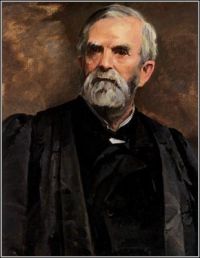
Portrait of William Burnham Woods William Burnham Woods Rowell v. Lindsay — Opinion of the Court

Instead of stiffening the shank between the tooth and the beam, it rather brings an increased strain upon that part of the shank. We find, therefore, that the curved upper part of the shank used by defendants does not perform one of the material functions of the brace-bar of the plaintiffs' combination. It cannot, therefore, be the equivalent of the latter. For where one patented combinais asserted to be an infringement of another, a device in one, to be the equivalent of a device in the other, must perform the same functions.
Source: Wikisource

Portrait of William Burnham Woods William Burnham Woods Rowell v. Lindsay — Opinion of the Court

The ends of the bifurcated bar are drawn down by the bolt, E, or by the united action of the bolts, E and D, until clamped against the standard of the shovel with such force that the friction shall maintain the shovel in position while passing through mellow earth, but not so tight but that it will yield to an excessive resistance before force enough is applied to break the shovel.
Source: Wikisource

Portrait of William Burnham Woods William Burnham Woods Rowell v. Lindsay — Opinion of the Court

The advantages of the invention are thus stated: 'By the form given to the standard we obtain not only the gripe on the pivoted end, but also a gripe against the sides of the standard, so that from its form it must be moved in the direction of its length. A much less restraining force will then hold the standard with requisite tenacity.
Source: Wikisource

Get perspective with Kwize: daily news enlightened by great literature