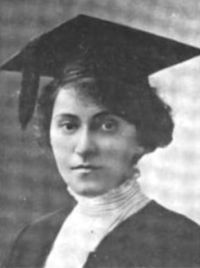
Ruth Edna Kelley

Ruth Edna Kelley

Summary

Portrait of Ruth Edna Kelley Ruth Edna Kelley The Book of Hallowe'en — VII. (1919)

Another story of about the same time was that of Angus, the son of
a Tuatha god, to whom in a dream a beautiful maiden appeared. He
wasted away with love for her, and searched the country for a girl
who should look like her. At last he saw in a meadow among a
hundred and fifty maidens, each with a chain of silver about her
neck, one who was like the beauty of his dream.
Source: Wikisource

Portrait of Ruth Edna Kelley Ruth Edna Kelley The Book of Hallowe'en — VII. (1919)

There are no Hallowe'en bonfires in Ireland now, but charms and
tests are tried. Apples and nuts, the treasure of Pomona, figure
largely in these. They are representative winter fruits, the
commonest. They can be gathered late and kept all winter.
A popular drink at the Hallowe'en gathering in the eighteenth
century was milk in which crushed roasted apples had been mixed. It
was called lambs'-wool (perhaps from "La Mas Ubhal," "the day of
the apple fruit") . At the Hallowe'en supper "callcannon," mashed
potatoes, parsnips, and chopped onions, is indispensable.
Source: Wikisource

Portrait of Ruth Edna Kelley Ruth Edna Kelley The Book of Hallowe'en — VII. (1919)

No place as much as Ireland has kept the belief in all sorts of
supernatural spirits abroad among its people. From the time when on
the hill of Ward, near Tara, in pre-Christian days, the sacrifices
were burned and the Tuatha were thought to appear on Samhain, to as
late as 1910, testimony to actual appearances of the "little
people" is to be found.
"'Among the usually invisible races which I have seen in Ireland,
I distinguish five classes. There are the Gnomes, who are
earth-spirits, and who seem to be a sorrowful race.
Source: Wikisource

Get perspective with Kwize: daily news enlightened by great literature