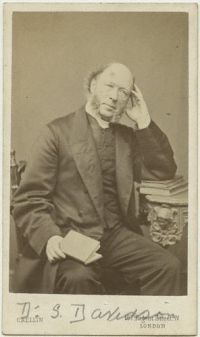
Samuel Davidson

Samuel Davidson

Summary

Portrait of Samuel Davidson Samuel Davidson The Canon of the Bible

Paul stood above the primitive apostles in the extent to which he fathomed the pregnant sayings of Jesus and developed their latent germs. Thus the normative element—that which determines the varying degrees of authority belonging to the New Testament—does not lie in apostolic authorship but internal worth; in the clearness and power with which the divine Spirit enabled men to grasp the truth. By distinguishing the temporal and the eternal in christianity, the writings necessarily rise or sink in proportion to these elements. The eternal is the essence and gem of revealed truth.
Source: Gutenberg

Portrait of Samuel Davidson Samuel Davidson The Canon of the Bible

Rabbinical Judaism proved its incapacity for regenerating the world; having no affinity for the philosophy of second [pg 048] causes, or for the exercise of reason beneath the love of a Father who sees with equal eye as God of all. Its isolation nourished a sectarian tendency. Tradition, having no creative power like revelation, had taken the place of it; and it could not ward off the senility of Judaism; for its creations are but feeble echoes of prophetic utterances, weak imitations of poetic inspiration or of fresh wisdom. They are of the understanding rather than the reason.
Source: Gutenberg

Portrait of Samuel Davidson Samuel Davidson The Canon of the Bible

Canonical authority lies in Scripture itself, and is inherent in the books so far as they contain a declaration of the divine will. Hence, there is truth in the statement of old theologians that the authority of Scripture is from God alone. It was the early church indeed that made the canon, selecting the books which appeared to have been written by apostles or apostolic men, and carrying over to them authority from alleged authenticity more than internal value.
Source: Gutenberg

Get perspective with Kwize: daily news enlightened by great literature