Summary

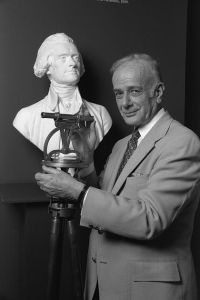
Portrait of Silvio A. Bedini Silvio A. Bedini Early American Scientific Instruments and Their Makers

The role of the instrument maker in the American Colonies was an important one—as it was in each epoch of the history of science in Europe—and it deserves to be reported.
To make a comprehensive study of American scientific instruments and instrument makers in the American Colonies is no simple matter, partly because of an indifference to the subject in the past, and partly because of the great volume of sources that must be sifted to accomplish it.
Source: Gutenberg

Portrait of Silvio A. Bedini Silvio A. Bedini Early American Scientific Instruments and Their Makers

For scientific instrument makers, one need only examine the nineteenth century city directories of Boston, Philadelphia and New York to find hundreds of names of craftsmen and firms. It is, to be sure, an antiquarian research, for one does not expect to find great discoveries coming from these people. But just as in Europe, it is a populous trade, influential in the growth of science and highly effective in spreading and intensifying the itch for ingenious instruments and devices.
Source: Gutenberg

Portrait of Silvio A. Bedini Silvio A. Bedini Early American Scientific Instruments and Their Makers

As the increasing preoccupation with subdivision of land and with surveying led to a greater demand for suitable instruments, it was the skilled craftsmen of the community, such as the clockmaker and the silversmith, that were called upon to produce them. Superb examples also were produced by the advanced scientific men, or "mathematical practitioners," of the period.
Colonial Training in Instrument Making
One may well ask, where did these native craftsmen acquire the knowledge that enabled them to produce so skillfully the accurate [Pg 9-10] and often delicate mathematical instruments?
Source: Gutenberg

Get perspective with Kwize: daily news enlightened by great literature