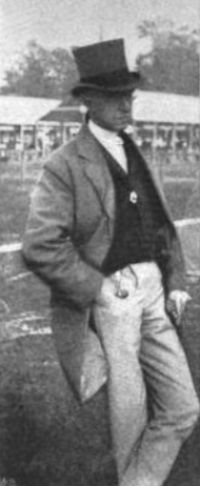
Sir Walter Gilbey

Sir Walter Gilbey

Summary

Portrait of Sir Walter Gilbey Sir Walter Gilbey Early Carriages and Roads

Very different was the case with the Royal Mail: every second was economised: at some places horses were changed within the space of a minute, and so jealously punctual were the coachmen that the village people set their clocks by the mail as it sped along the street. The Royal Mail paid no tolls, and if a turnpike keeper had not his gate open ready for its passage he was fined 40s. The passing of the London coach was the event of the day in quiet villages during the coaching age, as the guard performed the functions now discharged by the newspaper and telegraph wire.
Source: Gutenberg

Portrait of Sir Walter Gilbey Sir Walter Gilbey Early Carriages and Roads

Richard Lovell Edgeworth, in his Essay on the Construction of Roads and Carriages (1817) , tells us that in 1768 he discovered that springs were as advantageous to horses as to passengers, and constructed a carriage for which the Society of English Arts and Manufactures presented him with a gold medal. In this carriage the axletrees were divided and the motion of each wheel was relieved by a spring.
Travel in a springless coach over uneven streets and the roughest of roads could not have been a sufficiently luxurious mode of progress to lay the traveller open to charge of effeminacy.
Source: Gutenberg

Portrait of Sir Walter Gilbey Sir Walter Gilbey Early Carriages and Roads

We quote from “Coach and Sedan,” the curious little publication before referred to:—
“Coaches and Sedans (quoth the waterman) they deserve both to be thrown into the Thames, and but for stopping the Channel I would they were, for I am sure where I was wont to have eight or ten fares in a morning, I now scarce get two in a whole day. Our wives and children at home are ready to pine, and some of us are fain for means to take other professions upon us.”
Source: Gutenberg

Get perspective with Kwize: daily news enlightened by great literature