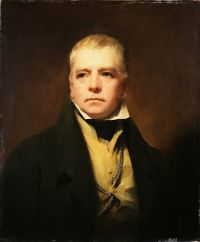
Sir Walter Scott

Sir Walter Scott

Summary

Portrait of Sir Walter Scott Sir Walter Scott,  Ivanhoe (unsourced) — Chapter 1 (1820)

“ At court, and in the castles of the great nobles, where the pomp and state of a court was emulated, Norman-French was the only language employed; in courts of law, the pleadings and judgments were delivered in the same tongue. In short, French was the language of honour, of chivalry, and even of justice, while the far more manly and expressive Anglo-Saxon was abandoned to the use of rustics and hinds, who knew no other. ”
Source: Wikisource

Portrait of Sir Walter Scott Sir Walter Scott,  Ivanhoe (unsourced) — Chapter 1 (1820)

“ Four generations had not sufficed to blend the hostile blood of the Normans and Anglo-Saxons, or to unite, by common language and mutual interests, two hostile races, one of which still felt the elation of triumph, while the other groaned under all the consequences of defeat. The power had been completely placed in the hands of the Norman nobility, by the event of the battle of Hastings, and it had been used, as our histories assure us, with no moderate hand. The whole race of Saxon princes and nobles had been extirpated or disinherited, with few or no exceptions ”
Source: Wikisource

Portrait of Sir Walter Scott Sir Walter Scott,  Ivanhoe (unsourced) — Chapter 1 (1820)

“ One word to Reginald Front-de-Boeuf, or Philip de Malvoisin, that thou hast spoken treason against the Norman, ---and thou art but a cast-away swineherd,---thou wouldst waver on one of these trees as a terror to all evil speakers against dignities."
"Dog, thou wouldst not betray me," said Gurth, "after having led me on to speak so much at disadvantage?"
"Betray thee!" answered the Jester; "no, that were the trick of a wise man; a fool cannot half so well help himself---but soft, whom have we here?"
”
Source: Wikisource

Get perspective with Kwize: daily news enlightened by great literature