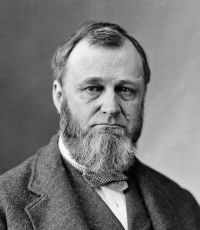
Spencer Fullerton Baird

Spencer Fullerton Baird

Summary

Portrait of Spencer Fullerton Baird Spencer Fullerton Baird 1911 Encyclopædia Britannica (1911)

In 1835 he combined the short circuit of his monster magnet (of 1834) with the small “intensity” magnet of an experimental telegraph wire, thereby establishing the fact that very powerful mechanical effects could be produced at a great distance by the agency of a very feeble magnet used as a circuit maker and breaker, or as a “trigger”—the precursor of later forms of relay and receiving magnets. In 1837 he paid his first visit to England and Europe.
Source: Wikisource

Portrait of Spencer Fullerton Baird Spencer Fullerton Baird 1911 Encyclopædia Britannica (1911)

Among many minor observations, he discovered in 1842 the oscillatory nature of the electrical discharge, magnetizing about a thousand needles in the course of his experiments (Proc. Am. Phil. Soc., 1, p. 301) . He traced the influence of induction to surprising distances, magnetizing needles in the lower story of a house through several intervening floors by means of electrical discharges in the upper story, and also by the secondary current in a wire 220 ft. distant from the wire of the primary circuit.
Source: Wikisource

Get perspective with Kwize: daily news enlightened by great literature