Summary

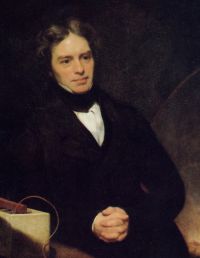
Portrait of Michael Faraday Michael Faraday The Forces of Matter — Magnetism…

To-day we come to a kind of attraction even more curious than the last, namely, the attraction which we find to be of a double nature—of a curious and dual nature. And I want, first of all, to make the nature of this doubleness clear to you. Bodies are sometimes endowed with a wonderful attraction, which is not found in them in their ordinary state. For instance, here is a piece of shellac, having the attraction of gravitation, having the attraction of cohesion, and if I set fire to it, it would have the attraction of chemical affinity to the oxygen in the atmosphere.
Source: Wikisource

Portrait of Michael Faraday Michael Faraday The Forces of Matter — Magnetism…

Well, it attracts one end, and it also attracts the other end, just as you saw the shellac and the glass did, with the exception of its not attracting in the middle. But if now, instead of a piece of iron, I take a magnet, and examine it in a similar way, you see that one of its ends repels the suspended magnet; the force, then, is no longer attraction, but repulsion; but, if I take the other end of the magnet and bring it near, it shows attraction again.
Source: Wikisource

Portrait of Michael Faraday Michael Faraday The Forces of Matter — Magnetism…

You see the spark in which it passes, and observe that the pith-ball indicator has fallen a little, which seems to imply that so much electricity is lost; but it is not lost; it is here in this brass, and I can take it away and carry it about, not because it has any substance of its own, but by some strange property which we have not before met with as belonging to any other force. Let us see whether we have it here or not. [The lecturer brought the charged cylinder to a jet from which gas was issuing; the spark was seen to pass from the cylinder to the jet, but the gas did not light.]
Source: Wikisource

Get perspective with Kwize: daily news enlightened by great literature