Summary

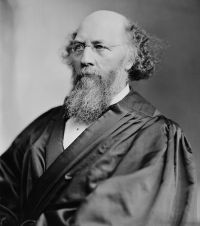
Portrait of Stephen Johnson Field Stephen Johnson Field Atchison v. Peterson — Opinion of the Court

The government, by its silent acquiescence, assented to the general occupation of the public lands for mining, and, to encourage their free and unlimited use for that purpose, reserved such lands as were mineral from sale and the acquisition of title by settlement. And he who first connects his own labor with property thus situated and open to general exploration, does, in natural justice, acquire a better right to its use and enjoyment than others who have not given such labor.
Source: Wikisource

Portrait of Stephen Johnson Field Stephen Johnson Field Atchison v. Peterson — Opinion of the Court

As respects the use of water for mining purposes, the doctrines of the common law declaratory of the rights of riparian owners were, at an early day, after the discovery of gold, found to be inapplicable or applicable only in a very limited extent to the necessities of miners, and inadequate to their protection. By the common law the riparian owner on a stream not navigable, takes the land to the centre of the stream, and such owner has the right to the use of the water flowing over the land as an incident to his estate.
Source: Wikisource

Portrait of Stephen Johnson Field Stephen Johnson Field Atchison v. Peterson — Opinion of the Court

A sand-gate at the head of the ditch is necessary, whether there is or is not mining on the stream above; and the accumulation of sand from all sources, from the hillsides as well as from the mining of the defendants, only requires the additional labor of one person for a few minutes each day. The injury thus sustained, and which is only to a limited extent attributable to the mining of the defendants, if at all, is hardly appreciable in comparison with the damage which would result to the defendants from the indefinite suspension of work on their valuable mining claims.
Source: Wikisource

Get perspective with Kwize: daily news enlightened by great literature