Summary

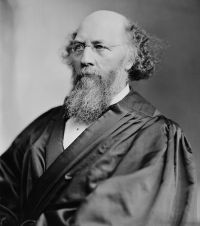
Portrait of Stephen Johnson Field Stephen Johnson Field Delaware Railroad Tax Minot v. Philadelphia Wilington and Baltimre Railroad Company…

The State may impose taxes upon the corporation as an entity existing under its laws, as well as upon the capital stock of the corporation or its separate corporate property. And the manner in which its value shall be assessed and the rate of taxation, however arbitrary or capricious, are mere matters of legislative discretion. It is not for us to suggest in any case that a more equitable mode of assessment or rate of taxation might be adopted than the one prescribed by the legislature of the State; our only concern is with the validity of the tax
Source: Wikisource

Portrait of Stephen Johnson Field Stephen Johnson Field Delaware Railroad Tax Minot v. Philadelphia Wilington and Baltimre Railroad Company…

For it is obvious that any apportionment of taxation according to the mileage of the road in each State must be purely arbitrary. No one would expect to find that the ratio of mileage of the road in Delaware, to its entire length, was the same as that of the capital invested in Delaware to the entire capital of the company, or that the proportion of Delaware stockholders could be ascertained in the same way.
Source: Wikisource

Portrait of Stephen Johnson Field Stephen Johnson Field Delaware Railroad Tax Minot v. Philadelphia Wilington and Baltimre Railroad Company…

The exercise of the authority which every State possesses to tax its corporations and all their property, real and personal, and their franchises, and to graduate the tax upon the corporations according to their business or income, or the value of their property, when this is not done by discriminating against rights held in other States, and the tax is not on imports, exports, or tonnage, or transportation to other States, cannot be regarded as conflicting with any constitutional power of Congress.
Source: Wikisource

Get perspective with Kwize: daily news enlightened by great literature