Summary

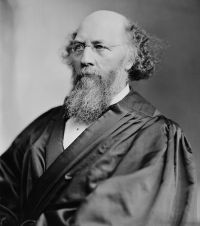
Portrait of Stephen Johnson Field Stephen Johnson Field Packer v. Bird — Opinion of the Court

In England, this limitation of the right of the riparian owner is confined to such navigable rivers as are affected by the tides, because there the ebb and flow of the tide constitute the usual test of the navigability of the streams. No rivers there, at least none of any considerable extent, are navigable in fact, which are not subject to the tides. In this country the situation is wholly different. Some of our rivers are navigable for many hundreds of miles above the limits of tidewater, and by vessels larger than any which sailed on the seas when the common-lawrule rule was established.
Source: Wikisource

Portrait of Stephen Johnson Field Stephen Johnson Field Packer v. Bird — Opinion of the Court

It is, indeed, the susceptibility to use as highways of commerce which gives sanction to the public right of control over navigation upon them, and consequently to the exclusion of private ownership, either of the waters or the soils under them. The commonlaw doctrine on this subject prevailing in England is held in some of the states, but in a large number has been considered as inapplicable to the navigable waters of the country, or even if prevailing for a time has given way, or been greatly modified, under the different conditions there.
Source: Wikisource

Portrait of Stephen Johnson Field Stephen Johnson Field Packer v. Bird — Opinion of the Court

It properly belongs to the states by their inherent sovereignty, and the United States has wisely abstained from extending, if it could extend, its survey and grants beyond the limits of high water.' The legislation of congress for the survey of the public lands recognizes the general rule as to the public interest in waters of navigable streams without reference to the existence or absence of the tide in them.
Source: Wikisource

Get perspective with Kwize: daily news enlightened by great literature