Summary

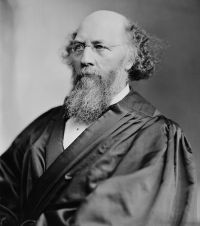
Portrait of Stephen Johnson Field Stephen Johnson Field Scott v. Neely — Opinion of the Court

An action at law, whether in the ancient form of ejectment or in the form now commonly used, will lie only against a party in possession. Should suit be brought in the federal court, under the Nebraska statute, against a party in possession, there would be force in the objection that a legal controversy was withdrawn from a court of law.' There is nothing in that decision that gives sanction to the enforcement in the federal courts of any rights created by state law which impair the separation there required between actions for legal demands and suits for equitable relief.
Source: Wikisource

Portrait of Stephen Johnson Field Stephen Johnson Field Scott v. Neely — Opinion of the Court

In all cases where a court of equity interferes to aid the enforcement of a remedy at law there must be an acknowledged debt, or one established by a judgment rendered, accompanied by a right to the appropriation of the property of the debtor for its payment; or, to speak with greater accuracy, there must be, in addition to such acknowledged or established debt, an interest in the property or a lien thereon created by contract or by some distinct legal proceeding.
Source: Wikisource

Portrait of Stephen Johnson Field Stephen Johnson Field Scott v. Neely — Opinion of the Court

The Code of Mississippi gives to a simple contract creditor a right to seek in equity, in advance of any judgment or legal proceedings upon his contract, the removal of obstacles to the recovery of his claim caused by fraudulent conveyances of property. There the whole suit, involving the determination of the validity of the contract, and the amount due thereon, is treated as one in equity, to be heard and disposed of without a trial by jury.
Source: Wikisource

Get perspective with Kwize: daily news enlightened by great literature