Summary

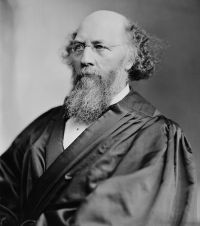
Portrait of Stephen Johnson Field Stephen Johnson Field Wharton v. Wise — Opinion of the Court

The articles inhibiting any treaty, confederation, or alliance between the states without the consent of congress were intended to prevent any union of two or more states, having a tendency to break up or weaken the league between the whole. They were not designed to prevent arrangements between adjoining states to facilitate the free intercourse of their citizens, or remove barriers to their peace and prosperity
Source: Wikisource

Portrait of Stephen Johnson Field Stephen Johnson Field Wharton v. Wise — Opinion of the Court

The appellant, a citizen of Maryland, is under a judgment of imprisonment for not paying a fine and costs of prosecution imposed for unlawfully catching and taking oysters in the waters of Virginia in violation of its laws. That state is the owner of the navigable waters within its limits and the lands under them, holding them in trust for the public, and authorized to pass all necessary laws for the protection of the fish therein, whether floating or shell, and the punishment of any citizens of its own or other states for taking them against its prohibitions.
Source: Wikisource

Portrait of Stephen Johnson Field Stephen Johnson Field Wharton v. Wise — Opinion of the Court

Where any particular word is obscure, or of doubtful meaning, taken by itself, its obscurity or doubt may be removed by reference to associated words; and the meaning of a term may be enlarged or restrained by reference to the object of the whole clause in which it is used.
'Looking at the clause in which the terms 'compact' or 'agreement' appear, it is evident that the prohibition is directed to the formation of any combination tending to the increase of political power in the states, which may encroach upon or interfere with the just supremacy of the United States.
Source: Wikisource

Get perspective with Kwize: daily news enlightened by great literature