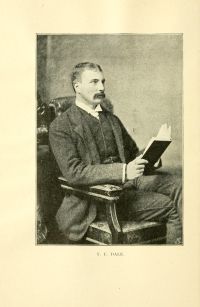
Thomas Francis Dale

Thomas Francis Dale

Summary

Portrait of Thomas Francis Dale Thomas Francis Dale 1911 Encyclopædia Britannica (1911)

Each individual player must be a good horseman, able to make a pony gallop, must have a control of the ball, hitting hard and clean and in the direction he wishes it to go. He must keep his eye on the ball and yet know where the goal-posts are, must be careful not to incur penalties and quick to take advantage of an opportunity. Polo gives no time for second thoughts. A polo player must not be in a hurry, but he must never be slow nor dwell on his stroke. He must be able to hit when galloping his best pace on to the ball and able to use the speed of his pony in order to get pace.
Source: Wikisource

Portrait of Thomas Francis Dale Thomas Francis Dale 1911 Encyclopædia Britannica (1911)

Indian polo has a lighter ball, no boards to the grounds, which are usually full-sized; a modified offside-rule, but the same system of penalties. It is a quicker game than the English. (12) The American game has no offside and no penalties, in the English sense. The attack is stronger, the passing longer, the pace greater and more sustained. American players are more certain goal-hitters and their scoring is higher.
Source: Wikisource

Portrait of Thomas Francis Dale Thomas Francis Dale 1911 Encyclopædia Britannica (1911)

The Hurlingham and Ranelagh clubs appoint official umpires. There should also be a referee in case of disagreement between the umpires, and it is usual to have a man with a flag behind each goal to signal when a goal is scored. The Hurlingham club makes and revises the rules of the game, and its code is, with some local modifications, in force in the United Kingdom, English-speaking colonies, the Argentine Republic, California, and throughout Europe. America and India are governed by their own polo associations.
Source: Wikisource

Get perspective with Kwize: daily news enlightened by great literature