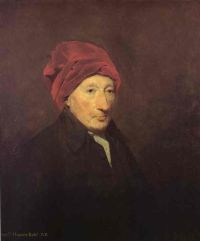
Thomas Reid

Thomas Reid

Summary

Portrait of Thomas Reid Thomas Reid An Essay on Quantity (1843)

If some mathematician should take it in his head to affirm, that the velocity of a body is not as the space it passes over in a given time, but as the square of that space, you might bring mathematical arguments and experiments to confute him; but you would never by these force him to yield, if he was ingenuous in his way; because you have no common principles left you to argue from, and you differ from one another, not in a mathematical proposition, but in a mathematical definition.
Source: Wikisource

Portrait of Thomas Reid Thomas Reid An Essay on Quantity (1843)

Let us next hear the Leibnitzian, who says, that the force of a body is as the square of its velocity. If he lays this down as a definition, I shall rather agree to it, than quarrel about words, and for the future shall understand him, by a quadruple force, to mean that which gives a double velocity, by nine times the force that which gives three times the velocity, and so on in duplicate proportion. While he keeps by his definition, it will not necessarily lead him into any error in mathematics or mechanics.
Source: Wikisource

Portrait of Thomas Reid Thomas Reid An Essay on Quantity (1843)

You will find none that is more simple, more distinct, or more agreeable to the common use of the word force: and he that rejects one definition that has these properties, has equal right to reject any other. I say, then, that it is impossible, by mathematical reasoning or experiment, to prove that the force of a body is as its velocity, without taking for granted the thing you would prove, or something else that is no more evident than the thing to be proved.
Source: Wikisource

Get perspective with Kwize: daily news enlightened by great literature