Summary

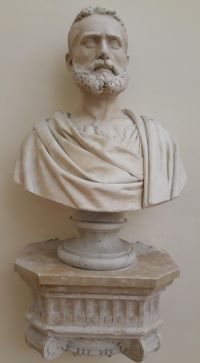
Portrait of Vitruvius Vitruvius Ten Books on Architecture — Book X - Chapter III - The Elements of Motion

Again, take the case of oars, which are fastened to the tholes by loops, — when they are pushed forward and drawn back by the hand, if the ends of the blades are at some distance from the centre, the oars foam with the waves of the sea and drive the ship forward in a straight line with a mighty impulse, while her prow cuts through the rare water.
Source: Wikisource

Portrait of Vitruvius Vitruvius Ten Books on Architecture — Book X - Chapter III - The Elements of Motion

For, as the shorter fore part of the lever goes under the weight from the fulcrum that forms the centre, the head of it, which is farther away from that centre, on being depressed, is made to describe a circular movement, and thus by pressure brings to an equilibrium the weight of a very great load by means of a few hands. Again, if the tongue of an iron lever is placed under a weight, and its head is not pushed down, but, on the contrary, is heaved up, the tongue, supported on the surface of the ground, will treat that as the weight, and the edge of the weight itself as the fulcrum.
Source: Wikisource

Portrait of Vitruvius Vitruvius Ten Books on Architecture — Book X - Chapter III - The Elements of Motion

So, too, the pilot of the biggest merchantman, grasping the steering oar by its handle, which the Greeks call οἱαξ, and with one hand bringing it to the turning point, according to the rules of his art, by pressure about a centre, can turn the ship, although she may be laden with a very large or even enormous burden of merchandise and provisions.
Source: Wikisource

Get perspective with Kwize: daily news enlightened by great literature