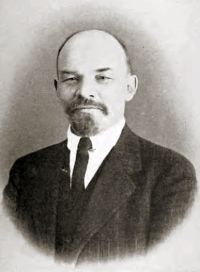
Vladimir Ilyich Lenin

Vladimir Ilyich Lenin

Summary

Portrait of Vladimir Ilyich Lenin Vladimir Ilyich Lenin The Land Revolution in Russia (1919)

So long as our Revolution was still preoccupied with this problem, so long as we had still to strain every nerve to the end that an independent peasant movement, assisted by the workers in the towns, might really sweep away and finally destroy the power of the landowners—so long our Revolution remained essentially the work of the entire peasantry, and for that reason could not free itself from its bourgeois setting. It did not as yet touch the stronger, the more up-to-date enemy of all workers—that is, Capitalism.
Source: Wikisource

Portrait of Vladimir Ilyich Lenin Vladimir Ilyich Lenin The Land Revolution in Russia (1919)

If we have succeeded in the village itself in awakening class-consciousness amongst the labouring peasantry; if, by the very agency of the Capitalist revolts, its interests have been separated from those of the Capitalist class; if the labouring peasants, in their committees of the poor and their reconstructed Soviets, are becoming more and more closely united with the workers of the towns—then we have the only, the truest, the best pledge that the work of Socialist reconstruction in Russia has been put at last on a firm footing.
Source: Wikisource

Portrait of Vladimir Ilyich Lenin Vladimir Ilyich Lenin The Land Revolution in Russia (1919)

The toiling poorest peasantry, which made most sacrifices for the Revolution, suffered most in the war, did not take the land away from the landlords in order to give it to new vultures. Life itself is bringing that toiling peasantry face to face with the question of passing to communal tillage as the only way of restoring the civilisation ruined and broken by the war, as the only way to escape from that darkness, ignorance and oppression to which Capitalism hitherto condemned the whole mass of the rural population.
Source: Wikisource

Get perspective with Kwize: daily news enlightened by great literature