Summary

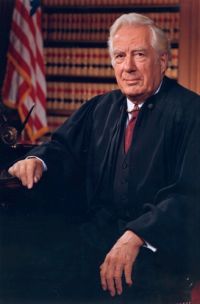
Portrait of Warren E. Burger Warren E. Burger California v. Ciraolo — Opinion of the Court (1986)

As Justice Harlan emphasized,
"a man's home is, for most purposes, a place where he expects privacy, but objects, activities, or statements that he exposes to the 'plain view' of outsiders are not 'protected' because no intention to keep them to himself has been exhibited. On the other hand, conversations in the open would not be protected against being overheard, for the expectation of privacy under the circumstances would be unreasonable."
Source: Wikisource

Portrait of Warren E. Burger Warren E. Burger California v. Ciraolo — Opinion of the Court (1986)

Whether respondent therefore manifested a subjective expectation of privacy from all observations of his backyard, or whether instead he manifested merely a hope that no one would observe his unlawful gardening pursuits, is not entirely clear in these circumstances. Respondent appears to challenge the authority of government to observe his activity from any vantage point or place if the viewing is motivated by a law enforcement purpose, and not the result of a casual, accidental observation.
Source: Wikisource

Portrait of Warren E. Burger Warren E. Burger California v. Ciraolo — Opinion of the Court (1986)

In an age where private and commercial flight in the public airways is routine, it is unreasonable for respondent to expect that his marijuana plants were constitutionally protected from being observed with the naked eye from an altitude of 1,000 feet. The Fourth Amendment simply does not require the police traveling in the public airways at this altitude to obtain a warrant in order to observe what is visible to the naked eye.
Source: Wikisource

Get perspective with Kwize: daily news enlightened by great literature