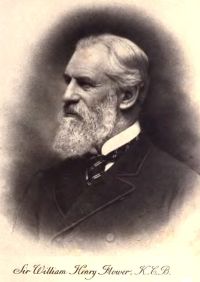
William Henry Flower

William Henry Flower

Summary

Portrait of William Henry Flower William Henry Flower Encyclopædia Britannica, Ninth Edition (1888)

The singular fact of the existence of so closely allied animals as the Malayan and the American tapirs in such distant regions of the earth and in no intervening places is accounted for by what is known of the geological history of the race, for, if we may judge from the somewhat scanty remains which have been preserved to our times, consisting chiefly of teeth, the tapirs must once have had a very wide distribution.
Source: Wikisource

Portrait of William Henry Flower William Henry Flower Encyclopædia Britannica, Ninth Edition (1888)

One of the most striking external characteristics of the walrus is the pair of tusks which descend almost directly downwards from the upper jaw, sometimes attaining a length, in old animals, of 20 inches, or even more. In the female they are as long or sometimes longer than in the male, but less massive. In the young of the first year they are not visible. These tusks correspond to the upper canine teeth of other mammals. All the other teeth, including the lower canines, are much alike—small, simple, and one-rooted, and with crowns, rounded at first, but wearing to a flat or concave surface.
Source: Wikisource

Portrait of William Henry Flower William Henry Flower Encyclopædia Britannica, Ninth Edition (1888)

Though formerly found in immense herds, it is rapidly becoming scarce, as the methods of destruction used by the American whalers, who have systematically entered upon its pursuit, are far more certain and deadly than those of the native Tchuktchis, to whom, as mentioned before, the walrus long afforded the principal means of subsistence.
Source: Wikisource

Get perspective with Kwize: daily news enlightened by great literature