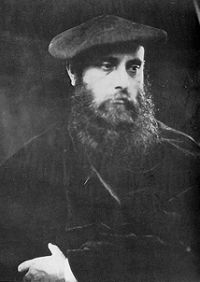
William Michael Rossetti

William Michael Rossetti

Summary

Portrait of William Michael Rossetti William Michael Rossetti 1911 Encyclopædia Britannica, Volume 20… (1911)

In his works the first quality which strikes one is their palatial splendour. The pictorial inspiration is entirely that of the piercing and comprehensive eye and the magical hand— not of the mind. The human form and face are given with decorous comeliness, often with beauty; but of individual apposite expression there is next to none. In fact, Paolo Veronese is pre-eminently a painter working pictorially, and in no wise amenable to a literary or rationalizing standard.
Source: Wikisource

Portrait of William Michael Rossetti William Michael Rossetti 1911 Encyclopædia Britannica, Volume 20… (1911)

Benedetto Caliari, the brother, who was about ten years younger than Paolo, is reputed to have had a very large share in the architectural backgrounds which form so conspicuous a feature in Paolo’s compositions. If this is not overstated, it must be allowed that a substantial share in Paolo’s fame accrues to Benedetto; for not only are the backgrounds admirably schemed and limned, but they govern to a large extent the invention and distribution of the groups. Of the two sons Carlo (or Carletto) , the younger, is the better known.
Source: Wikisource

Portrait of William Michael Rossetti William Michael Rossetti 1911 Encyclopædia Britannica, Volume 20… (1911)

PAUL VERONESE (1528–1588) , the name ordinarily given to Paolo Caliari, or Cagliari, the latest of the great cycle of painters of the Venetian school, who was born in Verona in 1528 according to Zanetti and others, or in 1532 according to Ridolfi. His father, Gabriele Caliari, a sculptor, began to train Paolo to his own profession. The boy, however, showed more propensity to painting, and was therefore transferred to his uncle, the painter Antonio Badile, whose daughter he eventually married.
Source: Wikisource

Get perspective with Kwize: daily news enlightened by great literature