“ Carlo Dolci's place in art is not altogether unlike that of some of his living countrymen in the world of music. There are Italian musicians known to all of us who have such a gift of sweetness that we cannot endure their melodies for long. A song now and again, or some sparkling little work for piano or violin, gives us a passing thrill of pleasure, and then we turn with complete content to the clearer atmosphere and more serene moods of the great masters whose works endure for all time. ”
Carlo Dolci
Definition and stakes
The theme of “Carlo Dolci” has been addressed by authors such as George Hay, Giacomo Casanova, William Michael Rossetti, E. V. Lucas and Lorinda Munson Bryant. It is often associated with terms like Dolly, painting, Florence, Dolcino and Mr..
Quotes about “Carlo Dolci”
“ So it is with Carlo Dolci; we go to him now and again, if only for a little while, conscious that sweetness as well as strength has its place in the world of art as in the world of music and letters. And we know, too, that criticism can say nothing worse about Carlo Dolci's gifts than that he was never able to turn them to the best account, that the rough diamond of his [76] talent was never in the hands of a competent lapidary. ”
“ Moreover Carlo Dolci laboured with a certain measure of sincerity until the message he had chosen to deliver to his generation became as true to him as the visions that helped Fra Angelico while he laboured in the cells of St. Mark's Convent in Florence. [17] To-day in Florence and in Rome the younger generation seek the pictures of Carlo Dolci and find in them a realisation of certain ideals. We may be a little shocked or even contemptuous, but to recognise the claims of those who are coming on as well as the claims of those who are passing, is to keep a sane outlook on life. ”
“ But neither a man nor his influence is everlasting; the great ones passed and left no successors; when Carlo Dolci appeared upon the scene the last trace of their influence had disappeared. Consequently he brought his gifts to a city from which inspiration [64] had departed. The great achievements of the art world were no more than echoes. Florence had excelled herself in all directions. Painting had served her greatest men as no more than one form of expression. ”
“ The greatest of them had sought to give their message to the world through the medium of more arts than one, and consequently, he who was a simpler painter was of comparatively small account. When Carlo Dolci was born, the time of great men having passed, no great forces were at work in his native city. He did not have the advantage of travel, he was never called upon to struggle hard and anxiously for the necessities of life. ”
“ Then, perhaps, some of us are even anxious to forget our former attitude towards the men who charmed our youthful fancy. We think we have become as gods, knowing good from evil, and in this mood we ignore the fine points of work we criticise. Carlo Dolci was in many ways a man who never grew up, but he had a keen and almost childish sense of beauty and of righteousness, and he sought to [16] express it on canvas, leaving the deeper truths of art, and the more important aspects of life, to be treated by those who cared to deal with them. Beauty obvious, palpable ”
“ His conscientiousness alone availed to check his output, and so intent was he upon expressing himself as well as he could within the obvious limitations of his gift that he never attempted to grapple with the problems that beset bigger men.In composition, for example, Carlo Dolci was distinctly deficient; there is no more serious charge against him as an artist than that he could not compose a large figure picture. ”
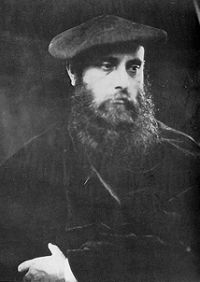 William Michael Rossetti,
1911 Encyclopædia Britannica, Volume 8…
(1911)
William Michael Rossetti,
1911 Encyclopædia Britannica, Volume 8…
(1911)
“ Carlo Dolci holds somewhat the same rank in the Florentine that Sassoferrato does in the Roman school. Without the possession of much genius, invention or elevation of type, both these artists produced highly wrought pictures, extremely attractive to some tastes. ”
“ He seems to afford an example of what talent will do when it lacks adequate direction, and we see too the danger into which the art of the painter falls when his inclinations are too literary. For it was no part of Carlo Dolci's aim in life to express harmonies in colour and line, although such expression may be taken to be the beginning and end of all that is greatest in painting. Dolci was always keen on telling a story, always intent upon preaching a sermon in paint, always forgetful that the provinces of art and literature have a very wide boundary line. ”
“ In 1682 Luca Giordano came to Florence to paint frescoes in the Chapel of the Corsini Palace. He admired Carlo Dolci's work very much, but used to rally him about the time he spent on it. "You do beautiful work, my Carlo," he said; "but how can you make it pay when you give hours and hours to that close finish? When I think of the 150,000 scudi I have earned since I took up the brush, I begin to fear that you will die hungry."PLATE VII.—PORTRAIT OF THE ARTISTThis is one of the collection of portraits of artists painted, each by his own hand. ”
“ The picture of an angel pointing out to Christian souls the road to Heaven attracted great comment and praise when it was painted; so too did two oval pictures, one of the Archbishop of Florence, and the other of St. Philip of Neri. A half-length figure of St. Catherine was another of the painter's notable works that may be referred to his middle life. He had acquired the art of giving to his canvas the high finish of a miniature, and his colours were very fresh and glowing. Indeed, it may be said of Carlo Dolci's work that it has preserved its freshness to a very remarkable extent ”
“ At the same time we must not underrate Carlo Dolci's work because we have outgrown it, since, as was suggested on an early page of this little essay, his charm in certain aspects is perennial, and although its powers to hold us must pass when we have turned to higher things, those who are following us will find pleasure and inspiration in the painter's art when they visit for the first time the galleries of Italy. They will travel by easy degrees from pictures that please to those that call in the first place for study, and then for admiration and the recognition of masterpieces. ”
“ The mere fact that Carlo Dolci's gifts found an immediate acceptance shows that the times were not distinguished, and we do not find in Baldinucci's life of his friend one solitary suggestion that any of the great rulers who employed his brush ever turned to him with the request that he [74] should enter into competition with those who had gone before, that he should take a course of study and learning to strengthen the weak points of his work, sacrificing a little of its sweetness to gain some small measure of strength. ”
“ But it is futile to complain of a man for being as Nature made him, and if we will turn to Carlo Dolci's pictures for pretty, agreeable, and highly finished interpretations of moral ideas in terms of paint, we shall find no small amount of momentary satisfaction. ”
“ It is rather interesting to compare the lives of Carlo Dolci and Fra Angelico of Fiesole, because each was a man who sought to express moral principles, sentiments, and belief on canvas, and, while the [72] one succeeded beyond all possibility of doubt, the other has met with only a modified success. Beato Angelico was influenced by the Dominicans as Dolci was by the Benedictines; each gave his life work to the service of the Church and the pursuit of virtues that the Church teaches man to practise. ”
“ No man's work can be judged properly save in relation to his circumstances and his time, and, in order that we may avoid the danger of underrating Carlo Dolci's achievement and dismissing for obvious faults what we should praise for merit, we are forced to consider the case carefully lest we treat a deserving man with injustice. Bearing time, place, and limitations in mind, it is possible then to consider the painter without the prejudice that the most glaring defects of his art are calculated to arouse. ”
“ INTRODUCTION IF, in dealing with the life and work of Carlo Dolci, a writer sets down an apology by way of preface, it is in recognition of the fact that the art form of this painter, for all that it is serious and beautiful, [12] is one of the first that we outgrow. There are artists in plenty, and their names are written large in the roll of fame, whose work makes no immediate appeal to us. ”
 E. V. Lucas,
A Wanderer in Florence
E. V. Lucas,
A Wanderer in Florence
“ Before leaving, look at the tiny Ignoto next the door—a Madonna and Child, the child eating a pomegranate. It is a little picture to steal.In the next room are a number of the later and showy painters, such as Carlo Dolci, Lorenzo Lippi, and Francesco Furini, all bold, dashing, self-satisfied hands, in whom (so near the real thing) one can take no interest. Nothing to steal here.Returning through Sala Prima we come to the Sala del Perugino and are among the masters once more—riper and richer than most of those we have already seen, for Tuscan art here reaches its finest flower. ”
“ We suffer from the painter's excess of sweetness, from a sentiment that comes dangerously near to sentimentality, from a quality that is almost as cloying as saccharine; but taken in the proper proportions, relegated to their proper place, the pictures [20] of Carlo Dolci are bound to please, and we feel perhaps a little envious of the man who throughout his life could see nothing that was not gracious and pleasing, and moral and sweet. ”
“ For the preparation of a canvas and the painting in of draperies for portraits the use of pupils may escape adverse criticism, but when the pressure of commission became very serious, too many great artists have succumbed to the temptation of leaving the bulk of the work [46] to be painted by a pupil, trusting to a few skilled touches to give the completed canvas the stamp of their own individuality. We have no means of saying how far Carlo Dolci indulged in a custom that was common to his time. ”
William Michael Rossetti,
1911 Encyclopædia Britannica, Volume 8…
(1911)
“ He afterwards painted a portrait of his mother, and displayed a new and delicate style which brought him into notice, and procured him extensive employment at Florence (from which city he hardly ever moved) and in other parts of Italy. Dolci used his pencil chiefly in sacred subjects, and bestowed much labour on his pictures. In his manner of working he was remarkably slow. ”
Lorinda Munson Bryant, The Children's Book of Celebrated Pictures
“ Every artist was willing to help him because he was always ready to do anything he could to help his brother artists.Raphael only lived to be thirty-seven. When he died all Italy mourned his death, and his funeral was one of the largest of any artist of his time.When Raphael was only twenty-one he painted the "Madonna del Gran' Duca." He had gone to Florence for the first time. We do not know where the picture was for a hundred years after it was painted; then the painter Carlo Dolci owned it. Again another hundred years went by, and we find it in possession of a poor widow. ”
“ Consequently the living painter of prettiness stands now at a certain disadvantage. Perhaps he is more handicapped in the struggle for recognition now than he [19] will be a hundred years hence, because we have but recently taken possession of our heritage of culture and judgment and are a little anxious to forget that we have been young. It may be granted that while a large collection of the works of a painter who laboured for all time pleases our every mood, it would be hard to live in a room in which Dolci's pictures dominated the walls. ”
“ Dolci would seem to have been ignored altogether, and this attitude of contempt is quite unfair, because no man who has pleased so many simple minds is unworthy of our attention, and it is more reasonable to praise a man for the gifts that were his than to ignore him on account of what he lacked. ”
“ His wife, who gave up much of her time and attention to him, suffered in health from the premature birth of a child, and then Baldinucci, who wrote the little biography of the artist that was printed in Florence in the early 'eighties, and is the foundation of our knowledge of the artist's life, took the painter away from Florence to the country to the house of one Domenico Valdinotti. This man, an artist, had one or two pictures in his studio commissioned for wealthy patrons. ”
“ There comes a time when the painter of pretty pictures and the writer of pretty songs cease to please us; we have mastered what we are pleased to regard as the tricks of both, and feel a little contempt for them. ”
“ Rembrandt, Velazquez, Tintoretto, one and all must be approached with an eye that has received some measure of training, and then the beauty of their work brings perennial enjoyment, though at first it could not be easily seen. Other men who lived and thought and wrought on quite a different plane appeal to the eye right away. ”
“ Yet he is by no means to be despised, for he saw through his own little [21] window a view of the pageantry of life that must have made him happy, and was destined to stimulate generations that have passed and generations still unborn. His pictures do not lack sincerity, and do not fail to express the best that was in him. He saw Holy Families and saints and living sitters with an eye that insisted upon beauty and righteousness. He painted with exquisite finish, with delicate colouring, and with a measure of enthusiasm that the years have not dimmed. ”
“ Beauty other than physical was entirely overlooked, or was associated deliberately with good looks. Handsome sinners were as far removed from the public ken as ugly saints. In many senses the world was younger than it is to-day ”
“ We know that Titian and Tintoretto and other masters of the Renaissance period in Italy never scrupled to avail themselves of the [45] services of clever pupils, and many a picture that left the studio with the master's name upon it did not receive more than the slightest touch of the master's brush. This scandal, for so we must describe it, has been common to nearly every period in the development of art, and was perhaps justified to some small extent in days when artists were not rewarded on a generous scale. ”
“ In short, though many men have done better, he did his best, and the pictures that are reproduced in these pages indicate very fairly the measure of his achievement, even while they do nothing to conceal his limitations. Moreover, while greater artists have had their biographers by the score, it is hard to find in the literature of Great Britain, France, or Italy any work dealing even in the simplest [22] fashion with this painter's life, though it does not deserve to be neglected. ”
“ If he had to devote himself to one, under the terms of some commission from a wealthy patron, he would not hesitate [67] to go to other masters in search of a composition that would suit his purpose. It may be put to his credit that he did these things openly, he does not seem to have claimed for himself the work that he borrowed from his contemporaries. In fact, it is quite probable that he knew his gifts did not lie in the direction of composition ”
“ Their work conceals nothing, its beauties are patent and entirely free from reticence or subtlety; such painters bear the same relation to the really great masters of the art as the writers of the songs sung at Ballad Concerts bear to the composers of the Pastoral, Unfinished or Pathetic Symphonies. Yet in their way it must be admitted that both the [14] writer of ballads, and the painter of pictures that please, do a certain service. They help the uninitiated along the path that leads to higher things; they are a support that the timid explorer may rely upon until he has learnt to walk alone. ”