“ Truly the word of a Queen and the patronage of the great are mighty factors in the world of letters!""As men of letters are fast learning, my young friend," replied the Duke with a smile. "Genius without a patron is like (as some wag remarked not long since) 'Paradise Lost' without the devil! ”
Patron
Definition and stakes
A patron is an honorary individual or entity that supports another through resources, influence, or advocacy. Across literature and history, this role has been both celebrated and scrutinized. Roger L’Estrange condemned patronage as a corrupting force that blinds justice, while Virginia Woolf viewed it as a necessary safeguard for creative work.
W. Somerset Maugham wryly longed for patronage as a means of literary survival, and Joseph Addison idealized patrons as benevolent guardians of societal welfare. These varied perspectives reveal the dual nature of patronage: a bridge between ambition and opportunity, yet one fraught with ethical complexity.
Quotes about “patron”
Roger L'Estrange, Fables of Æsop and Other Eminent Mythologists… (1692)
“ It is the Patron, and the Price of all Wickedness: It Blinds all Eyes, and stops all Ears, from the Prince to the very Begger. It Corrupts Faith and Justice; and in one Word, ’tis the very Pick-Lock, that opens the way into all Cabinets and Councils. ”
 W. Somerset Maugham,
Of Human Bondage
(1915)
W. Somerset Maugham,
Of Human Bondage
(1915)
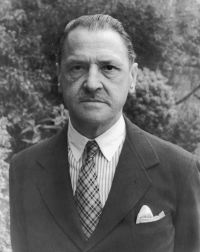
“ "I ought to have lived in the eighteen hundreds," he said himself. "What I want is a patron. I should have published my poems by subscription and dedicated them to a nobleman. I long to compose rhymed couplets upon the poodle of a countess. My soul yearns for the love of chamber-maids and the conversation of bishops." ”
 Virginia Woolf,
The Common Reader
(1925)
Virginia Woolf,
The Common Reader
(1925)
“ The patron we want, then, is one who will help us to preserve our flowers from decay. But as his qualities change from age to age, and it needs considerable integrity and conviction not to be dazzled by the pretensions or bamboozled by the persuasions of the competing crowd, this business of patron-finding is one of the tests and trials of authorship. ”
Reginald Herbert Mason, Pictures of life in Mexico/Volume 2 (1852)
“ If you meet him on equal terms, and desire to enter into conversation, he immediately gives you to perceive that he patronizes you. Employ him in the meanest capacity—whether he waits upon you at table, feeds your mule, or furnishes you with boots, spurs or wearing apparel and you remunerate him fourfold—he is still your patron. ”
Henry James, ../../ (1909)
“ The young man's expression became after this fashion something vivid and concrete—a beautiful personal presence, that of a prince in very truth, a ruler, warrior, patron, lighting up brave architecture and diffusing the sense of a function. ”
William Duane, A military dictionary
“ Every superior officer, from the commander in chief to the lowest non-commissioned officer, may, in a military sense, be called a patron; for it is the duty of all persons, in authority, to countenance, support, and protect every executive member in the service. Partialities on the other hand, (whatever may be their sources) are the bane of order and good discipline. In proportion as merit finds patrons among the good and great, indolence and inability should be discountenanced and degraded. ”
 Joseph Addison,
The Tatler, Volume 4
Joseph Addison,
The Tatler, Volume 4
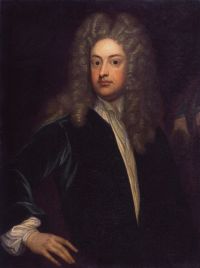
“ But on the other side, how beautiful is the life of a patron who performs his duty to his inferiors? a worthy merchant [Pg 21] who employs a crowd of artificers? a great lord who is generous and merciful to the several necessities of his tenants? a courtier who uses his credit and power for the welfare of his friends? These have in their several stations a quick relish of the exquisite pleasure of doing good. In a word, good patrons are like the guardian angels of Plato, who are ever busy, though unseen, in the care of their wards ”
 G. K. Chesterton,
What I saw in America
(1922)
G. K. Chesterton,
What I saw in America
(1922)
“ This patronage is allied to the patron, and the patron is allied to the aristocratic tradition of society. The larks are a variant of laziness because of leisure; and the leisure is a variant of the security and even supremacy of the gentleman. ”
 John Cassell,
Cassell's Illustrated History of England
(1865)
John Cassell,
Cassell's Illustrated History of England
(1865)
“ Whoever accepted the badge of any prince or nobleman, bound himself to support the cause of his patron, and the patron on his part to defend him against the officials of the law, of other hostile person. ”
 Arthur Murphy,
An Essay on the Life and Genius of Samuel Johnson
(1792)
Arthur Murphy,
An Essay on the Life and Genius of Samuel Johnson
(1792)
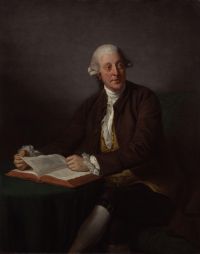
“ Such treatment I did not expect; for I never had a patron before." "The shepherd in Virgil grew acquainted with love, and found him a native of the rocks." "Is not a patron, my lord, one who looks with unconcern on a man struggling for life in the water, and, when he has reached ground, encumbers him with help? The notice which you have been pleased to take of my labours, had it been early, had been kind ”
John Richard Green, History of the English People, Volume III
“ A general esteem seems to have rewarded this rare instance of fidelity to a ruined patron. "For his honest behaviour in his master's cause he was esteemed the most faithfullest servant, and was of all men greatly commended." ”
 John Greenleaf Whittier,
Margaret Smith's Journal, and Tales and Sketches…
John Greenleaf Whittier,
Margaret Smith's Journal, and Tales and Sketches…
“ Work is here the patron saint. Everything bears his image and superscription. Here is no place for that respectable class of citizens called gentlemen, and their much vilified brethren, familiarly known as loafers. ”
Joseph Woods, Letters of an Architect, From France…
“ An institution on a much more moderate scale than even the one above mentioned, and such as would be within the reach of many English gentlemen, would be a very great advantage, and the patron would immortalize himself by it. ”
 Daniel Defoe,
A Treatise concerning the Use and Abuse of the Marriage Bed
(1727)
Daniel Defoe,
A Treatise concerning the Use and Abuse of the Marriage Bed
(1727)
“ A Pious and Reverend Minister, not of his Parish, but of a neighbouring Parish, and of which the Gentleman was Patron, frequently took Opportunities to talk seriously to him upon the sad Subject of his extravagant Life, and with a Christian plainness, tho' with decency and respect too, especially as he was his Patron, he often press'd him to take up, to reform, and, at least, to regulate his Morals. ”
 Plato,
Laws — The Preamble
(1875)
Plato,
Laws — The Preamble
(1875)
“ Due respect consists in going three times a month to the house of his patron, and offering to perform any lawful service for him; he must also marry as his master pleases; and if his property be greater than his master's, he must hand over to him the excess. ”
 Samuel Johnson,
The Lives of the Most Eminent English Poets
(1794)
Samuel Johnson,
The Lives of the Most Eminent English Poets
(1794)
“ Every man willingly gives value to the praise which he receives, and considers the sentence passed in his favour as the sentence of discernment. We admire in a friend that understanding that selected us for confidence; we admire more, in a patron, that judgement which, instead of scattering bounty indiscriminately, directed it to us; and, if the patron be an author, those performances which gratitude forbids us to blame, affectation will easily dispose us to exalt. ”
Blackwood's Magazine (1817 | noyear)
“ Men must see, hear, feel, and judge accordingly. And certainly in no other instance is a patron so responsible to his sovereign, his country, and his God, as in the choice he makes of spiritual pastors. These were some of the reflections that occupied my mind as I traversed this beautiful pastoral country with its morose teacher, and from these I was at length happily aroused by the appearance of the cottage, or shepherd's steading, to which we were bound. ”
Arthur E. R. Boak, A History of Rome to 565 A. D
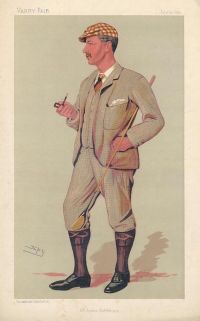
“ Each head of a patrician household was the patron of the clients who resided on his lands. The clients were obliged to follow their patrons to war and to the political arena, to render them respectful attention, and, on occasion, pecuniary support. ”
 Horace G. Hutchinson,
The greatest story in the world…
Horace G. Hutchinson,
The greatest story in the world…
“ In return, these clients would support their patron, as the great man was called, with their votes whenever they could be of use to him, and they would even accompany him about the city, in times of disturbance, as a kind of bodyguard. ”
 Fanny Chambers Gooch Iglehart,
Face to Face with the Mexicans
(1887)
Fanny Chambers Gooch Iglehart,
Face to Face with the Mexicans
(1887)
“ The patrona sits by and looks on serenely after counting over and over the piles, with satisfaction and self-importance emanating from her, and expressing in unspoken language—"You poor contemptible ”grinders” you have no position!" ”
N. D'Anvers, The Skirts of the Great City
“ In his delightful retreat the generous patron worked out the details of his scheme with the aid of his architect and other helpers, and in its grand {132} old hall he probably received the first master and warden of his new foundation, and nominated the earliest recipients of his bounty. ”
 Edward Bulwer-Lytton,
What Will He Do With It?
(1858)
Edward Bulwer-Lytton,
What Will He Do With It?
(1858)
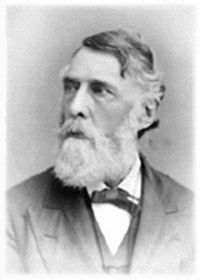
“ The public man needs but one patron—viz., THE LUCKY MOMENT. ”
 Benjamin Blake Minor,
The Southern Literary Messenger…
(1905)
Benjamin Blake Minor,
The Southern Literary Messenger…
(1905)
“ I am resolved that so far as lies in me, they shall not be; and I may say for those whose genius and learning have made the Messenger what it is, that they, too, are thus resolved. Let the hand of liberal patronage be opened and let the gifted minds pour forth their treasures, and the work shall prosper and shall be worthy of patronage. For myself, I desire only a fair compensation for my labors, on which I depend; and the rest shall gladly be given to the cause of literature and whatever credit there may be in the effort to promote its improvement and extension. ”
Oliver Goldsmith, An Enquiry Into the Present State of Polite Learning in Europe (1759)
“ When the link between patronage and learning was entire, then all who deserved fame were in a capacity of attaining it. When the great Somers was at the helm, patronage was fashionable among our nobility. The middle ranks of mankind, who generally imitate the Great, then followed their example ”
Captain F. Brinkley, Japan: Its History, Arts, and Literature (1902)
“ The numerous principalities which had supported their own artists and vied with one another to attract and retain the best skill in each era, ceased to exist. The patrician class, munificent and appreciative patrons of art in all ages, stepped down from their commanding positions to make way for the merchant and the manufacturer. ”
 Daniel Webster,
The Great Speeches and Orations of Daniel Webster
Daniel Webster,
The Great Speeches and Orations of Daniel Webster
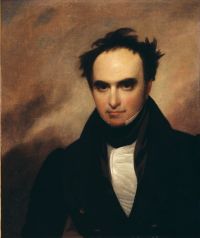
“ In the first place, it is to be remembered that patronage acts, not only on those who actually possess office, but on those also who expect it, or hope for it; and in the next place, office-holders, by their very situation, their public station, their connection with the business of individuals, their activity, their ability to help or to hurt according to their pleasure, their acquaintance with public affairs, and their zeal and devotion, exercise a degree of influence out of all proportion to their numbers. ”
 Carl Russell Fish,
The Civil Service and the Patronage…
(1905)
Carl Russell Fish,
The Civil Service and the Patronage…
(1905)
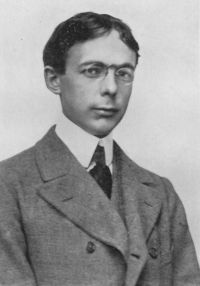
“ The leading words of the title limit each other; it is a history of the civil service from the standpoint of the patronage, and of the patronage with regard solely to the public offices. The aim has been to give fully the development of policy and practice as to the relation of these two elements of our public life, from the foundation of the government to the present day. ”
G. Hutchinson Smyth, The Life of Henry Bradley Plant
“ I would, however, have you recollect that we are the servants of the people, who are our patrons, to the extent that we must treat their property, while in our possession, with all the care we would our own. ”
Samuel Johnson,
The Works of Samuel Johnson, LL.D. in Nine Volumes…
“ The patronage of works which have a tendency towards advancing the happiness of mankind, naturally belongs to great princes; and publick good, in which publick elegance is comprised, has ever been the object of your majesty's regard. ”
J. Alfred Gotch, The English Home from Charles I. to George IV (1918)
“ The rest of mankind, however, concurred in the assumption, especially those who stood in need of patrons, and the literature of the eighteenth century makes it clear that noblemen and persons of quality wielded an influence which made their goodwill worth cultivating. ”
R. W. Browne, A History of Roman Classical Literature
“ Gifford. 401But there was a negative as well as a positive cause, the withdrawal of patronage. Literature, in order to flourish, requires the genial sunshine of human sympathy: it needs either the patronage of the great or the favour of the people. ”
The Babees' Book: Medieval Manners for the Young…
“ That these patrons really took an interest in their young servitors, and felt responsible for their welfare, appears in many accounts of help bestowed upon men who afterwards became famous in literature, or scholarship, or state-craft. ”
William Hunt, Dictionary of National Biography… (1885)
“ In his use of patronage he did not rise even to the highest standard of his time, for he conferred on his son at the age of sixteen the rich sinecure of the clerkship of the pells. On leaving office, however, he refused a peerage and a pension. ”
 Henry David Thoreau,
Yankee in Canada
(1866)
Henry David Thoreau,
Yankee in Canada
(1866)
“ There are nine hundred and ninety-nine patrons of virtue to one virtuous man. ”
Junius, Letters of Junius (1772)
“ A more active prince may, perhaps observe, with suspicion, by what degrees an artful servant grows upon his master, from the first unlimited professions of duty and attachment, to the painful representation of the necessity of the royal service, and soon, in regular progression, to the humble insolence of dictating in all the obsequious forms of peremptory submission. ”
The Great Events by Famous Historians…
“ I myself will be your general, judge, and rewarder of every one of your virtues in the field. I know already, for your forwardness, you have deserved rewards and crowns: and we do assure you, on the word of a prince, they shall be duly paid you. In the mean time my lieutenant-general shall be in my stead, than whom never prince commanded a more noble or worthy subject, not doubting but by your obedience to my general, by your concord in the camp, and your valor in the field we shall shortly have a famous victory over those enemies of my God, of my kingdom, and of my people. ”
Bernard Capes, The pot of basil (1913)
“ All this to-do about a piece of pleasantry that was nothing in itself, and should count for less than nothing in the context of that sincere and noble nature which condescends to honour you with its regard. The selection by such a prince of an instrument to sing his devotion in your ears should be enough to convince you of the high character of his deputy. But whether you like the chevalier or not, and whatever your sense of filial duty, you have got to endure him, that is all—aye, and to listen to him, too. ”
J. B. Priestley, Papers from Lilliput
“ But neither legend nor history shows us the fellow of him whom I praise. Even in the most magnificent figures of hospitality there is some flaw; emperor or oligarch, merchant-prince or baron, not one but shows some motive outside pure benevolence, some speck of pride, some touch of self-seeking. ”
 Miguel de Cervantes Saavedra,
The Exemplary Novels of Cervantes
Miguel de Cervantes Saavedra,
The Exemplary Novels of Cervantes
“ To which the man of glass replied, "The honour of the master exalts the honour of the servant. You, therefore, who call those who hire your mules your masters, see whom you serve, and what honour you may borrow from them; for your employers are some of the dirtiest rubbish that this earth endures. ”

“ Pardon an old servant, your father’s old butler, gracious lady, who has had the honour to carry the baron in his arms—and afterwards with humble submission to receive many a box o’ the ear from you—if he thinks it his duty to make his congratulations with due reverence on this happy day, and to join with the muses in harmonious tunes on the lyre. ”
 James Fenimore Cooper,
Recollections of Europe
James Fenimore Cooper,
Recollections of Europe
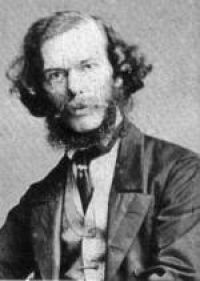
“ Nobles have been even employed by nobles; and it is still considered an honour for the child of a physician, or a clergyman, or a shopkeeper, in some parts of Europe, to fill a high place in the household of a great noble. The body servant, or the gentleman, as he is sometimes called even in England, of a man of rank, looks down upon a mechanic as his inferior. Contrary to all our notions as all this is, it is strictly reasonable, when the relative conditions, information, habits, and characters of the people are considered. ”
 Edward Dutton Cook,
Once a Week
(1861)
Edward Dutton Cook,
Once a Week
(1861)
“ His servants all had been years and years in his service, he had painted their portraits and hung them up in his house; there is homage to both master and servants in the fact. After all, a man may, if he chooses, be a hero even to his valet de chambre. ”
Oliver Prescott Hiller, God Manifest (1858)
“ When the master is bright and cheerful, the servant, reflecting its master's look, is brisk and alert, also,—ready to do cheerily it's lord's will and pleasure, when the master is dull, the servant is heavy and languid, too. ”
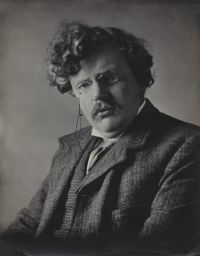 Gilbert Keith Chesterton,
The Innocence of Father Brown
(1911)
Gilbert Keith Chesterton,
The Innocence of Father Brown
(1911)
“ Suppose the servant really killed the master, or suppose the master isn't really dead, or suppose the master is dressed up as the servant, or suppose the servant is buried for the master; invent what Wilkie Collins' tragedy you like, and you still have not explained a candle without a candlestick, or why an elderly gentleman of good family should habitually spill snuff on the piano. ”
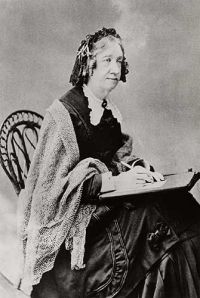 Catharine Esther Beecher,
American Woman's Home: Or, Principles of Domestic Science…
Catharine Esther Beecher,
American Woman's Home: Or, Principles of Domestic Science…
“ All English literature of the world describes domestic service in the old feudal spirit and with the old feudal language, which regarded the master as belonging to a privileged class and the servant to an inferior one. ”
Related terms
Authors who wrote about “patron”
Henry JamesRoger L'EstrangeW. Somerset MaughamVirginia WoolfReginald Herbert MasonWilliam DuaneJoseph AddisonG. K. ChestertonJohn CassellArthur MurphyJohn Richard GreenJohn Greenleaf WhittierJoseph WoodsDaniel Defoe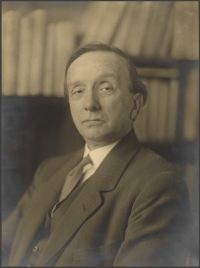 Arthur St. John AdcockPlatoSamuel JohnsonArthur E. R. BoakHorace G. HutchinsonN. D'Anvers
W. Somerset MaughamVirginia WoolfReginald Herbert MasonWilliam DuaneJoseph AddisonG. K. ChestertonJohn CassellArthur MurphyJohn Richard GreenJohn Greenleaf WhittierJoseph WoodsDaniel DefoeArthur St. John AdcockPlatoSamuel JohnsonArthur E. R. BoakHorace G. HutchinsonN. D'Anvers