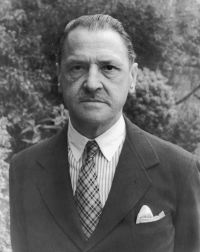
W. Somerset Maugham

W. Somerset Maugham

Summary

Portrait of W. Somerset Maugham W. Somerset Maugham Of Human Bondage (1915)

One evening, after due preparation, he took Philip and Lawson to a tavern situated in Beak Street, remarkable not only in itself and for its history—it had memories of eighteenth-century glories which excited the romantic imagination—but for its snuff, which was the best in London, and above all for its punch. Hayward led them into a large, long room, dingily magnificent, with huge pictures on the walls of nude women: they were vast allegories of the school of Haydon; but smoke, gas, and the London atmosphere had given them a richness which made them look like old masters.
Source: Gutenberg

Portrait of W. Somerset Maugham W. Somerset Maugham Of Human Bondage (1915)

The only way to live is to forget that you're going to die. Death is unimportant. The fear of it should never influence a single action of the wise man. I know that I shall die struggling for breath, and I know that I shall be horribly afraid. I know that I shall not be able to keep myself from regretting bitterly the life that has brought me to such a pass; but I disown that regret. I now, weak, old, diseased, poor, dying, hold still my soul in my hands, and I regret nothing."
"D'you remember that Persian carpet you gave me?" asked Philip.
Cronshaw smiled his old, slow smile of past days.
Source: Gutenberg

Portrait of W. Somerset Maugham W. Somerset Maugham Of Human Bondage (1915)

It seemed to Philip, listening with a smile on his lips, that the old tale fitted in with the scene. The sky was very blue now, and he thought it could not be more lovely even in Greece. The children with their fair hair and rosy cheeks, strong, healthy, and vivacious; the delicate form of the hops; the challenging emerald of the leaves, like a blare of trumpets; the magic of the green alley, narrowing to a point as you looked down the row, with the pickers in their sun-bonnets: perhaps there was more of the Greek spirit there than you could find in the books of professors or in museums.
Source: Gutenberg

Get perspective with Kwize: daily news enlightened by great literature